
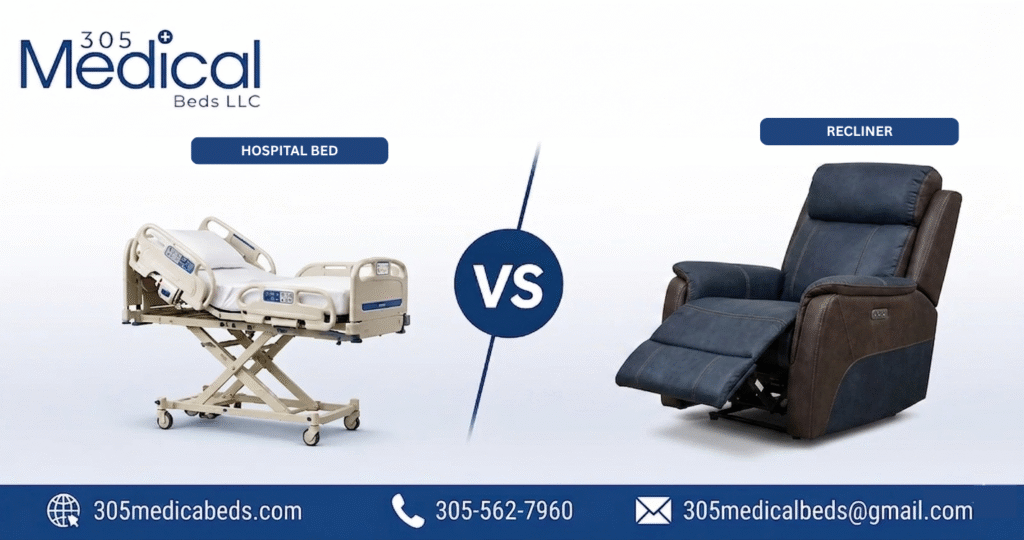
Hospital Bed vs Recliner: Which One Actually Helps Recovery at Home?
It’s a debate that happens in living rooms and hospital discharge meetings across the country every single day. Someone is coming home after surgery, or managing a chronic illness that makes lying flat impossible, and the question comes up: do we need an actual hospital bed or would a good recliner do the same job? It’s a fair question. Recliners are familiar. They don’t look medical. They’re already in many homes. And at first glance, an adjustable recliner that elevates the head and the legs seems to do what a hospital bed does just without the clinical associations and the price tag. Except that first glance is wrong in ways that matter. Not always recliners genuinely work for some situations. But for others, choosing a recliner over a hospital bed is a decision that leads to complications, falls, pressure ulcers, and caregiver injuries that didn’t need to happen. This article compares them honestly, round by round, and gives you a clear answer for the specific situations in which each one wins. 1. Sleep Quality and Overnight Positioning This is where the comparison opens up its biggest gap. Sleep real, restorative sleep requires more from a recovery surface than most people realize, and it’s the area where recliners fall furthest short, which can reassure patients and caregivers about the importance of proper support during recovery. A recliner positions you in a seated incline. Even fully reclined, most chairs don’t reach a true horizontal position you’re sleeping at roughly 30–40 degrees across your entire body. For a night or two after a procedure, this is manageable. For weeks of recovery, it creates problems. The seated posture compresses the lumbar spine and puts sustained pressure on the tailbone and thighs areas that are already under pressure from reduced mobility. It prevents the full muscle relaxation that the body needs during deep sleep, which can impact recovery quality and trust in the recovery process. A hospital bed solves this at every level. The four-section articulating deck head, seat, thigh, foot allows the patient to move between near-flat sleeping positions and elevated sitting positions fluidly, with the knee-break that prevents sliding. The full-flat position enables genuine muscular rest, giving caregivers peace of mind about pressure relief and comfort. Hospital Bed Recliner Full range of positions including true flat. Four-section deck prevents sliding. Pressure-relief mattress option. Patient can reposition independently during the night. Consumer cushion not rated for sustained clinical pressure loads. Concentrates weight on tailbone and thighs. No mechanism for systematic repositioning. Significant pressure ulcer risk for low-mobility patients. For any patient spending significant hours at rest with limited mobility, pressure ulcer risk from a recliner is clinically significant. A hospital bed with a medical mattress is not a comfort upgrade it’s a wound prevention tool. 2. Safety During Transfers Getting in and out of something whether a bed or a chair is one of the highest-risk moments of the recovery day. Most falls during home recovery happen during transfers, and the design of the piece of furniture determines how much risk each transfer carries. Getting out of a recliner requires pushing up from a seated position against the resistance of the reclined back or activating a lift mechanism that tilts the patient forward. Neither approach is smooth for someone with surgical restrictions, weakness, or pain. The standard recliner height is fixed; it does not adjust to the patient’s leg length or strength. And the arms of the chair, while helpful for pushing up, are often positioned in ways that require the patient to twist exactly the movement that post-hip and post-spine surgery patients are told to avoid. A hospital bed’s height adjustment changes everything about transfer safety. Lowering the bed so the patient’s feet are flat on the floor before any transfer and raising it to working height for caregiver assistance is the single most effective fall-prevention design feature in home medical equipment. Add half-rails that the patient can grip for stability during the transfer, and the mechanics of getting in and out become dramatically safer than any recliner can offer. Hospital Bed Recliner Height adjusts so feet are flat on floor before transfer. Half-rails provide stable grip point. Caregiver can raise bed to working height. Transfer risk dramatically reduced. Fixed height regardless of patient. Lift chairs help but can tip patient forward abruptly. No rail system. Pushing up from seated position requires strength and balance many recovery patients don’t have. Height-adjustable transfers with rail support versus fixed-height pushes with no grip system. The safety gap is significant and measurable in fall statistics. 3. Head and upper body elevation This is the round where recliners look strongest on paper and where the reality is more nuanced than it first appears. A recliner does elevate the upper body. For mild elevation needs reducing acid reflux, propping up slightly for comfort it works. But the elevation a recliner provides is not controllable in the same way as a hospital bed’s head section. Most recliners offer a handful of preset positions or a continuous reclining arc with no fixed stop points. You can’t set “35 degrees and hold it there” the way a hospital bed’s pendant allows you to. More importantly, recliner elevation moves the entire body together back, hips, and legs all shift as one unit. A hospital bed’s head section elevates independently of the lower body. This matters enormously for clinical positioning. When a heart failure patient needs their upper body elevated for breathing while their legs stay relatively flat to reduce pressure a hospital bed accommodates this. A recliner cannot separate the two. For patients who simply need to sleep slightly elevated for comfort or mild reflux, a recliner may be adequate in the short term. For anyone with a respiratory condition, cardiac condition, or post-surgical positioning requirement, independent head-section control is a clinical necessity, not a preference. Hospital Bed Recliner Head section elevates independently of lower body. Precise angle control via pendant. Any position from 0° to 75°. Clinical positioning for CHF, COPD,