
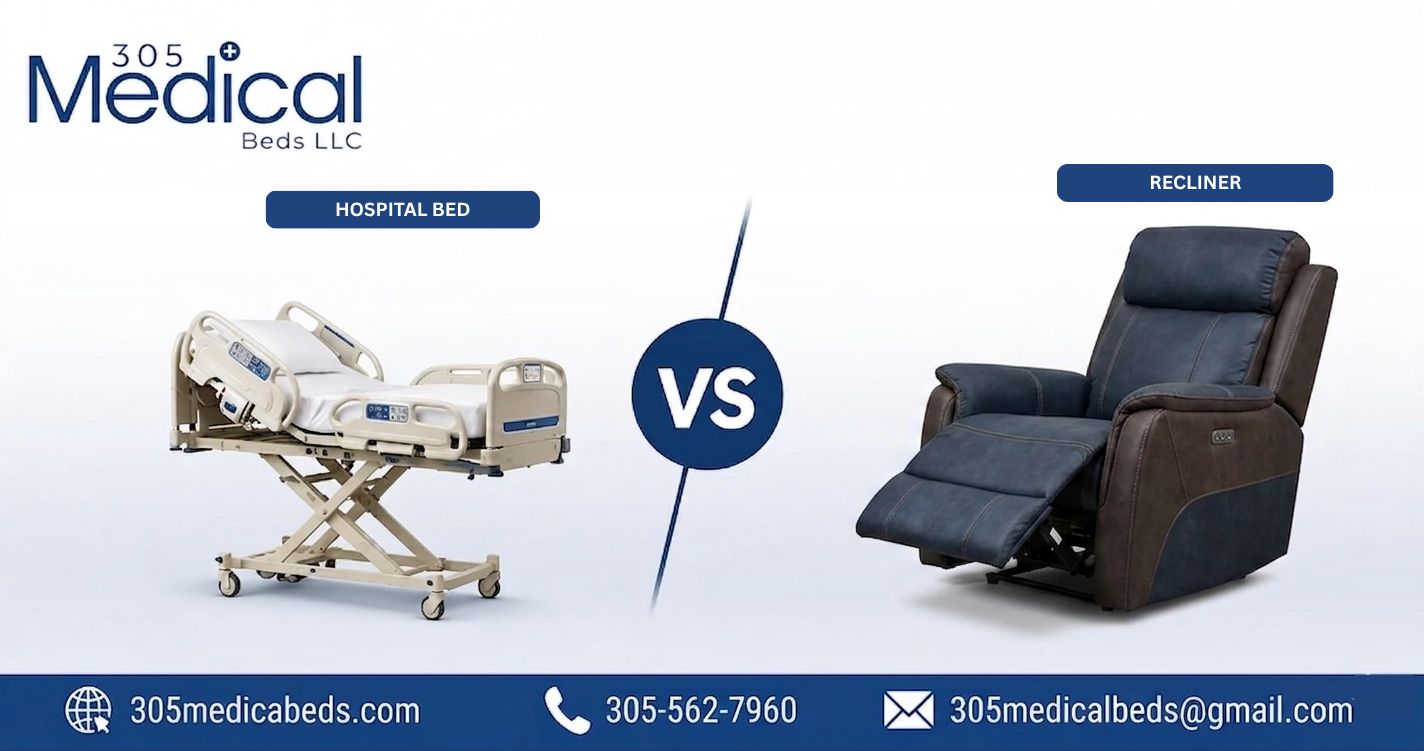
It’s a debate that happens in living rooms and hospital discharge meetings across the country every single day. Someone is coming home after surgery, or managing a chronic illness that makes lying flat impossible, and the question comes up: do we need an actual hospital bed or would a good recliner do the same job?
It’s a fair question. Recliners are familiar. They don’t look medical. They’re already in many homes. And at first glance, an adjustable recliner that elevates the head and the legs seems to do what a hospital bed does just without the clinical associations and the price tag.
Except that first glance is wrong in ways that matter. Not always recliners genuinely work for some situations. But for others, choosing a recliner over a hospital bed is a decision that leads to complications, falls, pressure ulcers, and caregiver injuries that didn’t need to happen.
This article compares them honestly, round by round, and gives you a clear answer for the specific situations in which each one wins.
1. Sleep Quality and Overnight Positioning
This is where the comparison opens up its biggest gap. Sleep real, restorative sleep requires more from a recovery surface than most people realize, and it’s the area where recliners fall furthest short, which can reassure patients and caregivers about the importance of proper support during recovery.
A recliner positions you in a seated incline. Even fully reclined, most chairs don’t reach a true horizontal position you’re sleeping at roughly 30–40 degrees across your entire body. For a night or two after a procedure, this is manageable. For weeks of recovery, it creates problems. The seated posture compresses the lumbar spine and puts sustained pressure on the tailbone and thighs areas that are already under pressure from reduced mobility. It prevents the full muscle relaxation that the body needs during deep sleep, which can impact recovery quality and trust in the recovery process.
A hospital bed solves this at every level. The four-section articulating deck head, seat, thigh, foot allows the patient to move between near-flat sleeping positions and elevated sitting positions fluidly, with the knee-break that prevents sliding. The full-flat position enables genuine muscular rest, giving caregivers peace of mind about pressure relief and comfort.
| Hospital Bed | Recliner |
| Full range of positions including true flat. Four-section deck prevents sliding. Pressure-relief mattress option. Patient can reposition independently during the night. | Consumer cushion not rated for sustained clinical pressure loads. Concentrates weight on tailbone and thighs. No mechanism for systematic repositioning. Significant pressure ulcer risk for low-mobility patients. |
For any patient spending significant hours at rest with limited mobility, pressure ulcer risk from a recliner is clinically significant. A hospital bed with a medical mattress is not a comfort upgrade it’s a wound prevention tool.
2. Safety During Transfers
Getting in and out of something whether a bed or a chair is one of the highest-risk moments of the recovery day. Most falls during home recovery happen during transfers, and the design of the piece of furniture determines how much risk each transfer carries.
Getting out of a recliner requires pushing up from a seated position against the resistance of the reclined back or activating a lift mechanism that tilts the patient forward. Neither approach is smooth for someone with surgical restrictions, weakness, or pain. The standard recliner height is fixed; it does not adjust to the patient’s leg length or strength. And the arms of the chair, while helpful for pushing up, are often positioned in ways that require the patient to twist exactly the movement that post-hip and post-spine surgery patients are told to avoid.
A hospital bed’s height adjustment changes everything about transfer safety. Lowering the bed so the patient’s feet are flat on the floor before any transfer and raising it to working height for caregiver assistance is the single most effective fall-prevention design feature in home medical equipment. Add half-rails that the patient can grip for stability during the transfer, and the mechanics of getting in and out become dramatically safer than any recliner can offer.
| Hospital Bed | Recliner |
| Height adjusts so feet are flat on floor before transfer. Half-rails provide stable grip point. Caregiver can raise bed to working height. Transfer risk dramatically reduced. | Fixed height regardless of patient. Lift chairs help but can tip patient forward abruptly. No rail system. Pushing up from seated position requires strength and balance many recovery patients don’t have. |
Height-adjustable transfers with rail support versus fixed-height pushes with no grip system. The safety gap is significant and measurable in fall statistics.
3. Head and upper body elevation
This is the round where recliners look strongest on paper and where the reality is more nuanced than it first appears.
A recliner does elevate the upper body. For mild elevation needs reducing acid reflux, propping up slightly for comfort it works. But the elevation a recliner provides is not controllable in the same way as a hospital bed’s head section. Most recliners offer a handful of preset positions or a continuous reclining arc with no fixed stop points. You can’t set “35 degrees and hold it there” the way a hospital bed’s pendant allows you to.
More importantly, recliner elevation moves the entire body together back, hips, and legs all shift as one unit. A hospital bed’s head section elevates independently of the lower body. This matters enormously for clinical positioning. When a heart failure patient needs their upper body elevated for breathing while their legs stay relatively flat to reduce pressure a hospital bed accommodates this. A recliner cannot separate the two.
For patients who simply need to sleep slightly elevated for comfort or mild reflux, a recliner may be adequate in the short term. For anyone with a respiratory condition, cardiac condition, or post-surgical positioning requirement, independent head-section control is a clinical necessity, not a preference.
| Hospital Bed | Recliner |
| Head section elevates independently of lower body. Precise angle control via pendant. Any position from 0° to 75°. Clinical positioning for CHF, COPD, post-surgical all achievable. | Entire body moves together cannot separate upper from lower. Limited preset positions on most models. Cannot achieve clinical independent positioning for respiratory or cardiac patients. |
For mild elevation, a recliner is adequate. For anything clinical CHF, COPD, post-surgical positioning independent head section control is necessary and the recliner cannot provide it.
4. Pressure Ulcer Prevention
Pressure ulcers bed sores are not just a hospital problem. They are the most common and most preventable serious complication of home recovery for patients with limited mobility, and the choice between a recliner and a hospital bed has a direct, measurable impact on risk.
A recliner concentrates pressure on a small number of contact points the tailbone, the backs of the thighs, and the shoulder blades for extended periods. The foam cushioning in even a high-quality recliner is not designed or tested for the sustained pressure loads of a patient who spends 10–18 hours a day in the same piece of furniture. There is no mechanism for systematic repositioning built into the recliner’s design. The patient either moves themselves requiring mobility they may not have or they don’t move, and the pressure accumulates.
A hospital bed, paired with a proper medical mattress foam, alternating pressure, or low-air-loss distributes weight across a much larger and more dynamic surface. The four-section deck allows position changes that relieve pressure at different body points throughout the day and night. An alternating pressure mattress actively redistributes pressure every few minutes without any patient movement at all. None of this is possible in a recliner.
The math on pressure ulcers is severe: Stage 3 and 4 pressure ulcers can cost $20,000–$150,000 to treat, depending on severity. They extend hospital stays, require wound care specialists, and carry a meaningful mortality risk in frail elderly patients. A hospital bed with the right mattress costs a fraction of treating a single serious pressure ulcer. Read how to choose the right pressure-relief mattress.
| Hospital Bed | Recliner |
| Compatible with alternating pressure and low-air-loss mattresses. Four-section deck enables position changes without patient standing. Designed for extended use under clinical load conditions. | Consumer cushion not rated for sustained clinical pressure loads. Concentrates weight on tailbone and thighs. No mechanism for systematic repositioning. Significant pressure ulcer risk for low-mobility patients. |
For any patient spending significant hours at rest with limited mobility, pressure ulcer risk from a recliner is clinically significant. A hospital bed with a medical mattress is not a comfort upgrade it’s a wound prevention tool.
5. Caregiver ergonomics
The person providing care gets a vote in this decision too. And for caregivers usually family members without clinical training or clinical-grade backs the choice of furniture makes a significant difference in whether they can sustain care without injuring themselves.
Providing care to someone in a recliner means working around a piece of furniture designed for one person to sit in, not for two people to interact with. Reaching over the arms to assist with positioning, bending low to access the legs, or supporting someone out of a tipped-forward lift mechanism these are awkward, back-intensive activities performed dozens of times each day.
A hospital bed raised to caregiver hip height turns every care task into a standing task. Repositioning, wound care, bathing, dressing — performed at the right height, these are manageable. Performed bent over a recliner or a low bed, they accumulate into the back injuries that affect 60% of family caregivers within a year. The height adjustment on a full-electric bed exists as much for the caregiver as for the patient.
| Hospital Bed | Recliner |
| Raises to caregiver hip height for all care tasks. Eliminates bending and reaching. Standard of care for preventing caregiver musculoskeletal injury. Lower caregiver fatigue = sustainable long-term care. | Fixed height. Awkward access around chair arms. Care tasks require bending and twisting. Not designed for caregiver interaction. Significant ergonomic risk for sustained home care situations. |
Caregiver health is not a secondary concern. A hospital bed that protects the caregiver’s back is also protecting the patient’s access to sustainable care.
6. Cost and Accessibility
This is the round the recliner wins and it genuinely wins it. A quality power recliner costs $500–$2,000. A lift chair that assists with standing transitions costs $500–$3,000. A certified refurbished hospital bed from a local supplier starts around $1,990 and goes up from there.
But the cost comparison has two dimensions that change the math significantly. First, Medicare Part B covers hospital beds as Durable Medical Equipment for qualifying patients covering 80% of the approved cost, potentially reducing out-of-pocket to $400 or less. Medicare covers no part of the cost of a recliner or lift chair, regardless of medical need. Second, rental is available for hospital beds typically $150–$400 per month which makes the entry cost lower than purchasing for short-term recovery needs.
A recliner is also more immediately accessible available at furniture stores, online, without a prescription. For families who need something today and don’t have time to navigate DME procurement, a recliner can fill an immediate short-term gap while proper equipment is arranged.
| Hospital Bed | Recliner |
| Higher upfront cost ($1,990+ purchased). Requires prescription for Medicare coverage. Needs local DME supplier and delivery. Takes 48–72 hours to arrange in most cases. | Lower upfront cost ($500–$2,000). Available immediately at furniture stores. No prescription needed. Familiar furniture purchase process with no medical bureaucracy. |
On pure purchase cost and immediacy, the recliner wins. The gap narrows significantly for qualifying Medicare patients but for families buying out of pocket without time to navigate DME, the recliner is genuinely more accessible.
7. Appearance and Home Integration
We’re including this because it’s real. Families care about what their home looks like, and patients care about feeling like they’re living at home rather than in a medical facility. That’s not vanity it has a documented effect on mood, recovery motivation, and quality of life during what is already a difficult period.
A recliner is furniture. It blends into the living room. It doesn’t announce that something medical is happening. Guests don’t notice it. The patient sitting in it looks like someone relaxing, not someone recovering.
A hospital bed in a bedroom looks like a hospital bed. It changes the feel of the room. For some patients particularly those managing long-term chronic illness this becomes a significant quality-of-life issue that affects how they experience their own home.
The honest answer here is that hospital beds have gotten better-looking over time, and that a well-arranged room with a hospital bed can feel more homelike than people expect. But the recliner wins this round on appearance, and pretending otherwise wouldn’t be honest.
| Hospital Bed | Recliner |
| Clinical appearance. Changes the feel of the room. Signals “medical” to visitors and the patient. Can affect quality of life and mood in long-term use situations. | Looks like furniture. Integrates naturally into any room. No clinical signalling. For short-term use and patients sensitive to the appearance of their environment, genuinely preferable. |
Appearance matters for patient morale during recovery. The recliner wins this round cleanly. For some patients and families, this factor is significant enough to influence the overall decision.
Conclusion
The hospital bed wins five out of seven points but the two points the recliner wins (cost and appearance) are the ones that drive most families toward it in the first place. That’s the core of why this debate persists: the recliner wins on the factors that are immediately visible, and loses on the factors that only become apparent over time.
The recliner wins the first glance. The hospital bed wins the recovery.
Which One Is Right for Your Specific Situation?
The head-to-head score tells part of the story. But the right answer for your situation depends on who the patient is, what they’re recovering from, and how long the recovery is expected to take. Here’s a direct recommendation by condition:
Hip or Knee Replacement
Use a hospital bed
Post-hip surgery precautions (no bending past 90°, correct transfer side, safe height for getting up) require a hospital bed. A recliner violates hip precautions in its standard seated position.
Congestive Heart Failure
Use a hospital bed
CHF patients need upper body elevation independent of lower body something a recliner cannot provide. The clinical risk of inadequate positioning in CHF is measurable and serious.
COPD or Breathing Difficulty
Use a hospital bed
Respiratory patients need precise, sustained head elevation that holds at a clinical angle overnight. A recliner can approximate this but cannot match the stability, adjustability, or overnight comfort of a hospital bed’s head section.
Limited Mobility or Long-Term Bed Rest
Use a hospital bed
Any patient spending more than 4–6 hours at rest per day with limited ability to reposition is at meaningful pressure ulcer risk. Only a hospital bed with a medical mattress addresses this systematically.
Minor Surgery, Short Recovery
Recliner may be adequate
For a patient recovering from a minor outpatient procedure with full mobility expected within 1–2 weeks, a recliner for daytime sitting comfort is reasonable. Normal bed use should continue for sleeping.
Acid Reflux or Mild Sleep Elevation
Recliner may be adequate
For patients who simply need some head elevation during sleep, a bed wedge or consumer adjustable base (not a full hospital bed) may be sufficient. A recliner is less ideal than a wedge but workable for mild, non-clinical needs.
The Single Most Important Question to Ask
Before deciding between a hospital bed and a recliner, ask your patient’s doctor one question: “Are there specific positioning requirements or restrictions I need to follow during recovery?” If the answer is yes and it almost always is for surgical and cardiac patients those requirements will tell you exactly which piece of equipment can meet them. A recliner that violates a positioning restriction isn’t a cheaper option. It’s a liability.
What About A Lift Chair? Is It Different from A Recliner?
Lift chairs deserve a brief separate mention because they come up often in this conversation, and they are genuinely different from standard recliners in one important way.
A lift chair uses a motor to tilt the entire chair forward, bringing the patient to a near-standing position. This significantly reduces the effort required to stand up from a seated position useful for patients with hip pain, knee weakness, or general de-conditioning. For patients who struggle with standing transfers, a lift chair is a real improvement over a standard recliner.
But a lift chair is still a recliner in every other respect. It does not adjust in height the way a hospital bed does. It does not have a medical mattress. It does not allow independent upper-body positioning. It has no rail system. And its forward-tilting mechanism, while helpful, can be abrupt occasionally causing patients to overshoot to standing when they intended to sit on the edge. For post-hip surgery patients specifically, the mechanics of a lift chair can actually violate hip precautions if not used carefully.
A lift chair is a useful addition to a recovery environment. It is not a replacement for a hospital bed for patients who need one.
The Honest Bottom Line
A recliner is a piece of furniture. A hospital bed is a piece of medical equipment. They are built to different specifications, tested to different standards, and designed for different purposes. For mild, short-term, low-restriction recovery, a recliner can play a supporting role. For anything more any surgical restriction, any chronic condition, any extended period of limited mobility the hospital bed is the right tool and the recliner is an approximation that falls short in ways that accumulate over time.
The families who choose the recliner to save money or avoid the clinical appearance almost always come to us later sometimes after a fall, sometimes after a pressure ulcer has developed, sometimes just after months of poor sleep and an exhausted caregiver. The conversation at that point is always some version of: “I wish we’d done this from the start.”
That conversation is one we’d rather not have. Which is why we’re having this one instead.
Not sure which option is right for your situation?
Call us at 305 Medical Beds. We’ll ask a few questions about your patient’s condition, their mobility, and what the recovery looks like and give you an honest answer, even if that answer is that a recliner is sufficient for now. We’re a local South Florida team, not a call centre. The conversation is free.