
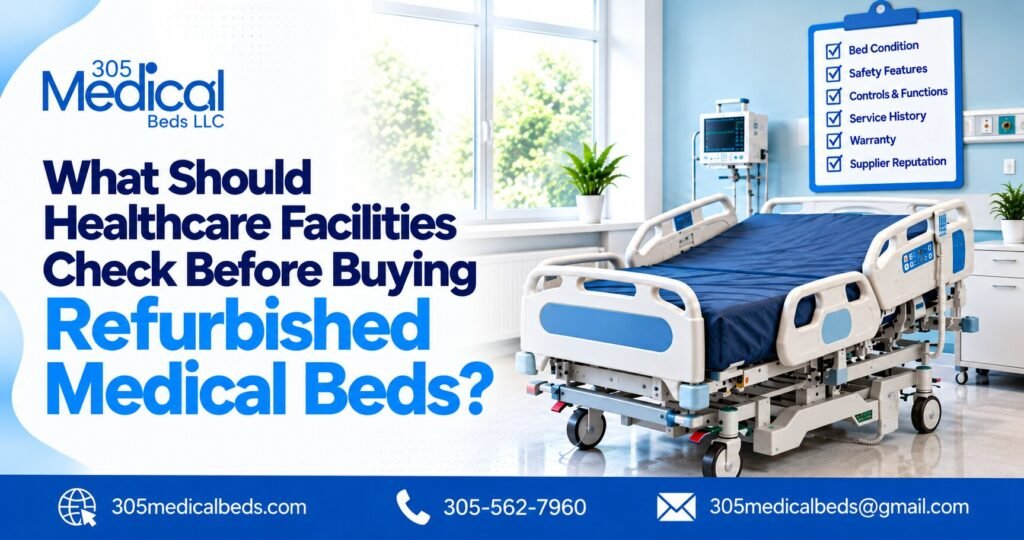
What Should Healthcare Facilities Check Before Buying Refurbished Medical Beds?
Healthcare facilities must balance patient safety, equipment reliability, operational requirements, and budget constraints when purchasing medical beds. For hospitals, nursing facilities, rehabilitation centers, and long-term care providers, refurbished medical beds can be an option worth evaluating when expanding capacity or replacing aging equipment. However, purchasing refurbished hospital beds requires more than comparing prices. Healthcare administrators and procurement teams should evaluate the bed’s structural condition, electrical functions, safety features, refurbishment quality, maintenance history, replacement parts, and supplier support before making a purchasing decision. A properly evaluated refurbished medical bed may help healthcare facilities manage equipment costs while meeting their patient care requirements. In this guide, we explain the most important factors to consider before purchasing refurbished medical beds and how to make a more informed buying decision. Why Do Healthcare Facilities Consider Refurbished Medical Beds? Healthcare facilities often need to expand patient capacity, replace aging equipment, or maintain reliable equipment availability without exceeding their budgets. Purchasing new medical beds for every replacement or expansion can represent a significant capital investment. Refurbished medical beds may provide an alternative, depending on the equipment model, condition, refurbishment process, and supplier. Some refurbished beds retain features such as adjustable positioning, electronic controls, integrated side rails, and height adjustment. However, the features available vary by manufacturer and model. Healthcare facilities should verify the specifications of each bed rather than assume that all refurbished models provide the same capabilities. Before comparing prices, procurement teams should identify the facility’s clinical requirements, expected usage, patient population, and maintenance capabilities. These factors help determine whether a particular refurbished medical bed is suitable for the intended setting. 1. Check the Bed’s Overall Condition and Structural Integrity The physical condition of a medical bed is one of the first things healthcare facilities should evaluate before purchasing refurbished equipment. Medical beds may experience wear from repeated adjustments, patient transfers, transportation, cleaning, and routine use. Refurbishment should address identified defects rather than simply improve the bed’s appearance. During an inspection, examine the following components: Healthcare facilities should request an inspection record documenting the bed’s condition and any repairs completed during refurbishment. A bed that looks clean and attractive is not necessarily mechanically sound. Structural integrity should be verified before the equipment is approved for clinical use. 2. Test Electrical Functions, Motors, and Controls Electric medical beds rely on motors, electrical components, and control systems to adjust the patient’s position and the bed’s height. These functions should be tested before the equipment is accepted. The exact functions available depend on the bed model. Some beds offer head and foot positioning, height adjustment, Trendelenburg positioning, or additional specialized functions. During the evaluation, ask the supplier to demonstrate every advertised function. Check that: Facilities should also request documentation of relevant electrical safety testing and servicing. Testing should be performed by appropriately qualified personnel using procedures suitable for the equipment. Do not approve a bed for patient use solely because its motors operate. The equipment must also meet the applicable safety requirements and manufacturer specifications for its intended environment. 3. Inspect Side Rails, Brakes, Wheels, and Safety Features Safety-related components require careful attention because they can affect patient transfers, bed movement, and daily clinical workflows. Start by inspecting the side rails, if fitted. Check for damage, secure attachment, smooth operation, and reliable locking mechanisms. Rails should operate according to the manufacturer’s instructions and be suitable for the intended patient and mattress configuration. Healthcare facilities should also evaluate the following features. Brakes and casters: Confirm that the braking system engages properly and that the wheels move and lock as specified. Inspect the casters for damage, excessive wear, or restricted movement. Height adjustment: Verify that the bed reaches its intended positions without unexpected movement or instability. Positioning controls: Ensure that the controls function correctly and that the bed responds predictably to adjustments. Pinch and entrapment hazards: Assess potential gaps around the mattress, rails, and moving sections. The suitability of these spaces depends on the bed design, mattress dimensions, and patient population. Emergency features: Where fitted, verify the operation of emergency release mechanisms and other model-specific safety functions. Patient safety also depends on how a bed is configured and used. Facilities should follow the manufacturer’s instructions, applicable safety guidance, and their own clinical risk assessment when selecting bed rails and other accessories. 4. Verify the Refurbishment Process and Maintenance History Not all refurbished medical beds undergo the same level of inspection or repair. One supplier may perform basic cleaning and limited repairs, while another may provide more extensive component replacement, functional testing, and documented quality checks. Healthcare facilities should understand exactly what refurbishment includes before purchasing. Ask the supplier: Where available, request serial numbers, model information, service records, and details of replacement components. A documented refurbishment process makes it easier for procurement teams to assess the equipment and compare suppliers fairly. Avoid relying on general descriptions such as “fully refurbished” without supporting documentation. The specific work completed and the tests performed are more useful than a label alone. 5. Check Mattress Compatibility and Infection Control A medical bed and its mattress should be evaluated as a compatible system. A mattress that is unsuitable for the bed can affect positioning, comfort, safety, and the performance of certain bed features. Before purchasing, verify the recommended mattress dimensions, thickness, type, and compatibility with the bed model. Consider whether the mattress is designed for the intended patient population and clinical setting. Facilities should also review the condition of the mattress and any supplied accessories. Check for: A mattress cover that appears clean may still have damage that is not immediately visible. Facilities should follow appropriate inspection procedures and replace components that cannot be safely cleaned or verified. The supplier should explain how the bed and included accessories were cleaned and prepared before delivery. Healthcare facilities must also apply their own infection prevention and equipment acceptance procedures before placing refurbished equipment into service. 6. Confirm the Manufacturer, Model, and Available Replacement Parts Before purchasing refurbished medical beds, identify the exact manufacturer and model. This information