
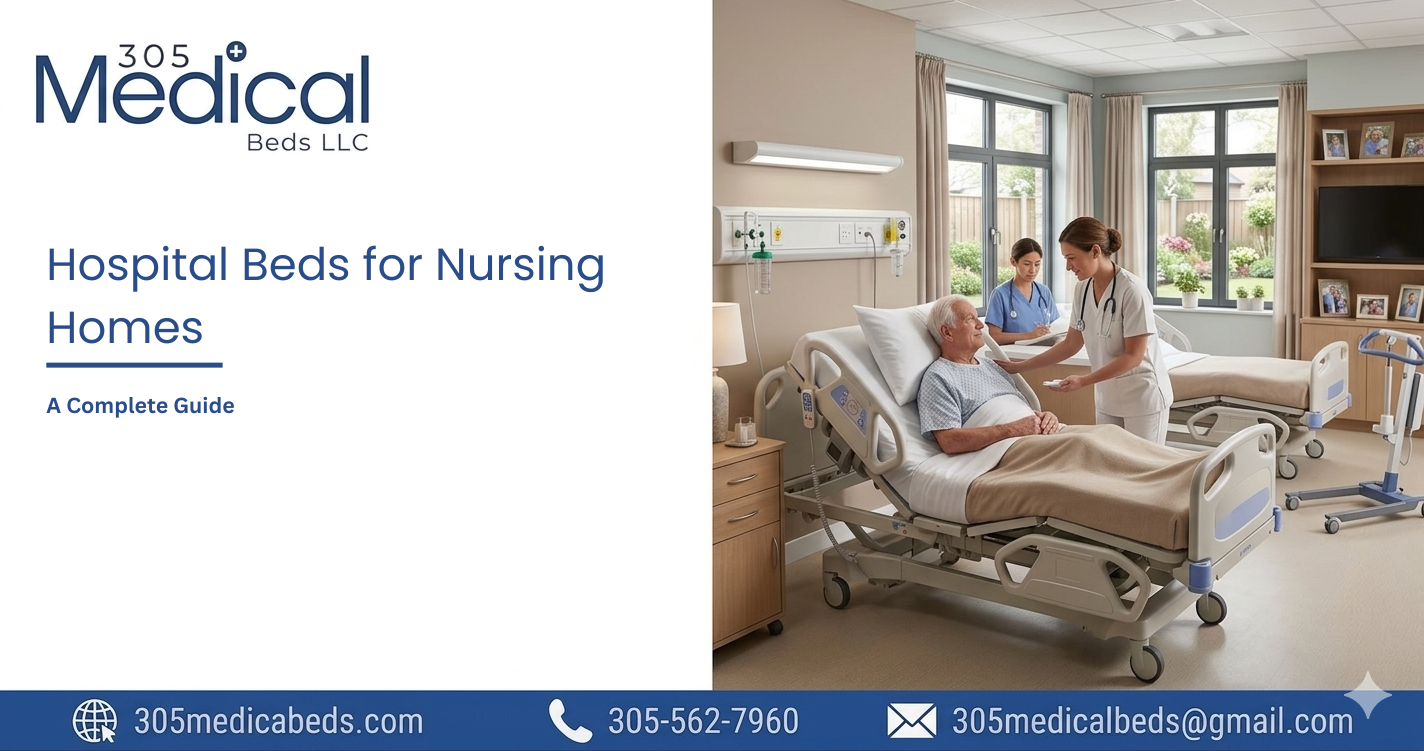
Buying hospital beds for a nursing home or assisted living facility is nothing like buying one bed for a home patient. You’re making decisions that affect dozens — sometimes hundreds — of residents simultaneously. One wrong specification can mean beds that don’t meet CMS compliance, staff injuries from improper ergonomics, or thousands of dollars in equipment that doesn’t hold up under the daily demands of a residential care setting.
This guide is written for facility administrators, directors of nursing, procurement managers, and operations teams who need to get the bed decision right the first time. We cover every factor that matters — from regulatory requirements and bed specifications to comparing new versus certified refurbished, negotiating volume pricing, and what to actually look for during a facility walkthrough before delivery.
15,600+
nursing homes operating in the US
1.2M
certified nursing home beds nationwide
40–60%
savings with certified refurbished vs new
7–10 yrs
typical lifespan of a well-maintained facility bed
Why the right hospital bed matters more in long-term care than anywhere else
In a hospital, the average patient stays 4–5 days. In a nursing home or long-term care facility, a resident may occupy the same bed for months or years. That changes everything about what the bed needs to do.
A long-term care bed is not just a place to sleep — it is where a resident eats, socialises, receives treatment, exercises, and spends the majority of their waking and sleeping hours. The consequences of a poor bed choice compound over time in ways that a short-stay hospital setting never experiences:
- Pressure ulcers develop over days and weeks of inadequate positioning — not hours. In long-term care, they represent one of the most common — and most legally costly — adverse events a facility faces
- Staff musculoskeletal injuries from manual handling are the leading cause of workers’ compensation claims in nursing homes, and the bed’s ergonomic design directly determines how much manual lifting staff perform daily
- Resident dignity and independence are affected every time a bed is too high to exit safely, too stiff to adjust, or missing features that would allow a resident to manage their own position
- Regulatory citations from CMS inspections can include bed-related findings — inadequate pressure relief, missing or broken side rails, or beds that don’t meet the resident’s assessed care needs
Getting the bed right is a clinical decision, a financial decision, and a risk management decision all at once. This guide addresses all three.
CMS regulations and compliance requirements for facility beds
Any nursing home that accepts Medicare or Medicaid residents — which is virtually every certified facility in the United States — must comply with CMS (Centers for Medicare and Medicaid Services) requirements under the Long-Term Care Facility Requirements of Participation. These regulations directly govern hospital beds in several important ways.
F-tag F686 — pressure ulcer prevention and treatment
CMS F-tag F686 requires facilities to ensure residents who enter without pressure ulcers do not develop them — and residents who have them receive appropriate treatment. The choice of mattress and bed positioning capabilities is considered part of meeting this requirement. Facilities cited under F686 face fines and in serious cases, loss of Medicare/Medicaid certification. A bed without adequate pressure-relief mattress compatibility is a compliance risk, not just a clinical one.
F-tag F700 — bed rails
CMS F-tag F700 governs the use of side rails in long-term care. Facilities must assess each resident individually before using full-length bed rails. Raised full rails on both sides without clinical justification can be cited as a restraint — a serious deficiency. Your beds must support half-rail configurations, and staff must be trained on the restraint assessment process. When purchasing beds, confirm the rail system supports both full and half-rail configurations without additional hardware costs.
F-tag F558 — resident environment
Residents have a right to a comfortable, safe living environment. This includes a bed that can be adjusted to the resident’s preference for height and position — not just what is convenient for staff. Full-electric beds with patient-accessible pendants directly support compliance with this tag. Manual-only beds may be cited if residents have the physical capability to self-adjust but are prevented from doing so by a non-electric bed.
Compliance resource
For the full CMS Long-Term Care Requirements of Participation, visit CMS.gov — Nursing Home Regulations. Review your facility’s most recent inspection report to identify any bed-related citation history before making a purchasing decision.
Which bed types are right for which residents
Long-term care facilities house a wide range of residents with very different care needs. A single bed type rarely serves all of them well. Here is how to match bed type to resident population:
Full-electric beds
Best for: most LTC residents
The standard of care in modern long-term care. All positioning — head, foot, and height — is electric and controlled via pendant. Residents with any degree of independent function can self-adjust. Staff can raise the bed to working height for care tasks without manual effort. Required for residents who need frequent repositioning or have respiratory, cardiac, or post-surgical conditions. The Hill-Rom Versacare P3200 and TotalCare P1900 are the most common full-electric models in US facilities. See our Hill-Rom Versacare guide.
Semi-electric beds
Best for: lower-acuity or budget-constrained wings
Head and foot sections are electric; height is manual crank. Acceptable for residents with lower acuity needs who do not require frequent height adjustments. Lower cost per unit than full-electric — suitable for assisted living wings where residents have more independence. Not recommended for ICU-level, bariatric, or high fall-risk residents in a nursing home setting.
Bariatric beds
Best for: residents over 350 lbs
Any facility with bariatric residents must have bariatric-rated beds. Using a standard bed for a resident who exceeds its weight capacity is both a safety violation and a structural failure waiting to happen. Bariatric beds support 600–1,000+ lbs, offer wider decks (42″–54″), and use reinforced motors and frames. The Hill-Rom TotalCare P1840 Bariatric Plus is the benchmark model for this category. Read our bariatric bed guide.
Low / ultra-low beds
Best for: high fall-risk residents
Lower to within 6–9 inches of the floor to minimise injury if a resident exits the bed without assistance. Essential for residents with dementia, delirium, or a history of falls. Most full-electric facility beds can lower to 9–11 inches. True ultra-low beds go to 6 inches or less. This is a growing requirement in dementia care units and memory care wings.
Pulmonary / ICU beds
Best for: skilled nursing / subacute units
For subacute and skilled nursing units caring for residents with complex medical needs post-hospitalisation, ICU-grade beds offer continuous lateral rotation therapy, advanced positioning (Trendelenburg, reverse Trendelenburg), and built-in monitoring compatibility. The Hill-Rom Progressa P7500 is the leading pulmonary bed for this use case. Read our Progressa P7500 guide.
Palliative / comfort beds
Best for: hospice and end-of-life wings
For residents in hospice or palliative care, comfort and dignity take priority over clinical features. A full-electric bed with a low-air-loss mattress, soft side panels, and a wood-grain or non-clinical appearance creates a more homelike environment — shown to reduce distress in end-of-life care settings. Some facilities use consumer-grade adjustable beds in private palliative rooms for this reason.
The 8 features every nursing home bed must have
Whether buying new or certified refurbished, every bed placed in a long-term care facility should meet these minimum feature requirements. These are not optional enhancements — they are clinical and operational necessities for a residential care setting.
Full height range
Must lower to at least 9″ for fall risk and raise to caregiver working height (27″–30″) for care tasks. The full height range reduces staff manual handling injuries.
4-section deck
Head, seat, thigh, and foot sections must all be independently adjustable. This is non-negotiable for pressure management and safe positioning of residents who cannot reposition themselves.
Half-rail compatible
Must support both full and half-rail configurations. Full-rail-only beds expose facilities to CMS F-tag F700 citations if rails are used as restraints without individual assessment.
Nurse control lockout
Staff must be able to lock the resident pendant to prevent self-adjustment after a prescribed position is set — critical for post-surgical, fall-risk, or cognitively impaired residents.
Alternating pressure mattress compatible
The bed deck must accept alternating pressure and low-air-loss mattress systems — including accommodating the pump unit. Not all bed frames allow this without modifications.
CPR release function
A single-action CPR release that lowers the entire deck to flat in under 3 seconds. Required for emergency response. This is a CMS-expected safety feature in any clinical setting.
Infection-control surfaces
All surfaces must be cleanable with hospital-grade disinfectants. Avoid textured or porous frame materials. Look for a sealed, smooth powder-coat finish with no crevices where pathogens can accumulate between residents.
Nurse call integration
The bed’s pendant should have a nurse call button that integrates with your facility’s nurse call system. Confirm compatibility with your current call system before purchasing — not all beds use the same connector standard.
Don’t skip the weight capacity check. The average American nursing home resident weighs more today than 20 years ago. Standard beds rated at 350 lbs may not be adequate for a growing portion of your population. Consider 450-lb rated beds as your standard specification, and ensure bariatric beds are available for residents requiring them. Using under-rated equipment is a liability and a safety incident waiting to happen.
New vs certified refurbished — the financial case for long-term care facilities
This is where most facility procurement decisions are won or lost. The instinctive preference for new equipment is understandable — but the financial math for certified refurbished makes a compelling case that most facility administrators haven’t fully examined.
The true cost of new hospital beds at facility scale
A new Hill-Rom TotalCare P1900 full-electric hospital bed costs approximately $12,000–$18,000. A new Hill-Rom Progressa P7500 pulmonary bed runs $20,000–$35,000. For a 60-bed facility replacing its entire inventory:
| Scenario | Per bed cost | 60-bed facility total |
|---|---|---|
| New Hill-Rom TotalCare P1900 | $14,000 avg | $840,000 |
| Certified refurbished Hill-Rom TotalCare P1900 | $3,000–$4,500 | $180,000–$270,000 |
| Savings with certified refurbished | ~$10,000/bed | $570,000–$660,000 |
That $570,000+ in savings can be reinvested in staffing, resident programming, facility improvements, or additional equipment. For a facility operating on thin Medicare and Medicaid reimbursement margins, this difference is not marginal — it is transformational.
What “certified refurbished” actually means
A certified refurbished hospital bed is not a used bed that’s been wiped down and repackaged. A proper refurbishment process — like the one used for beds sold by 305 Medical Beds — includes:
- Complete disassembly and deep cleaning to hospital infection-control standards
- Replacement of all wear components — motors, actuators, cables, pendant cords, brake pedals
- New mattress cover or full mattress replacement
- Fresh powder-coat paint on the frame
- Full electrical safety testing (ground continuity, leakage current)
- All mechanical function testing across the full range of motion
- Written inspection report and warranty documentation
The regulatory position on refurbished beds: CMS does not prohibit certified refurbished beds in nursing homes. What CMS requires is that beds are safe, functional, and meet the resident’s assessed care needs — regardless of whether they are new or refurbished. A well-maintained refurbished Hill-Rom bed meets all CMS requirements. Verify at CMS.gov.
Buying beds for a nursing home or care facility in South Florida?
305 Medical Beds offers volume pricing on certified refurbished Hill-Rom hospital beds — with professional delivery, facility-wide setup, and staff training included. Let’s talk about your specific needs.
Hill-Rom, Stryker and other brands — what long-term care facilities actually use
The hospital bed market for long-term care is dominated by two manufacturers. Understanding their product lines helps you specify the right bed — and buy refurbished more confidently because parts and service are widely available.
Hill-Rom (now Baxter) — the market leader
Hill-Rom beds are the most widely used hospital beds in US long-term care facilities. Their dominance means a large refurbished supply, widely trained service technicians, and extensive parts availability. Key models for long-term care:
Hill-Rom Versacare P3200
Best for: general LTC wards
The workhorse of long-term care. Full-electric, reliable, widely available refurbished at $1,990–$2,490. Straightforward controls that staff learn quickly. Accepts standard foam and air mattress systems. The most cost-effective choice for general ward beds. See the full Versacare guide.
Hill-Rom TotalCare P1900
Best for: higher-acuity LTC and SNF
Advanced positioning, built-in scale capability, lateral tilt options on some configurations. Ideal for subacute and skilled nursing units handling complex post-hospital residents. Widely available refurbished at $2,290–$3,490 depending on configuration. See the full TotalCare guide.
Hill-Rom Progressa P7500
Best for: pulmonary and subacute
Continuous lateral rotation therapy, advanced pulmonary support, Trendelenburg positioning. For facilities with a dedicated subacute or respiratory care unit. Higher investment but no alternative at this clinical level. Available refurbished from $7,290. See the full Progressa guide.
Hill-Rom TotalCare P1840 Bariatric Plus
Best for: bariatric residents
600+ lb capacity, 54″ deck width, reinforced frame throughout. The benchmark bariatric bed for US facilities. Every facility that serves bariatric residents should have at least a handful of these — improper equipment for bariatric residents is a top source of staff injuries and CMS citations. See the full Bariatric Plus guide.
Stryker — strong in acute care, less dominant in LTC
Stryker beds are more common in acute hospital settings than long-term care, but some facilities — particularly hospital-based skilled nursing units — use Stryker beds for consistency with their acute care inventory. Stryker’s InTouch and S3 models are occasionally seen in LTC. Parts and service are available but the refurbished market is thinner than Hill-Rom, which can make long-term support more expensive. Read our full Hill-Rom vs Stryker comparison.
Volume buying — what to negotiate and what to insist on
Buying ten or more beds puts you in a completely different negotiating position than a single-unit purchase. Here is what experienced facility procurement managers negotiate for — and what they insist on as non-negotiable contract terms.
What to negotiate
- Per-unit price breaks at volume thresholds — ask for the supplier’s volume pricing tiers. Most suppliers offer meaningful discounts at 10, 25, and 50+ units
- Phased delivery schedule — if your facility is running at capacity, you may need beds delivered wing by wing rather than all at once. Confirm the supplier can accommodate staged delivery without price penalties
- Extended warranty terms — standard warranties are 90 days to 1 year. For volume orders, negotiate 2-year parts and labour coverage
- Mattress inclusion — request that mattresses be included in the per-unit price rather than quoted separately
- Spare parts package — for large orders, negotiate a spare parts kit: extra pendants, brake pedals, rail locking pins. These are the components most likely to need replacement in the first year
What to insist on as non-negotiable
- Written refurbishment documentation for every unit — model, serial number, work performed, components replaced, test results
- On-site setup and function testing by trained technicians — not just delivery and offloading
- Staff training included — every staff member who operates the beds should receive a demonstration. This is not optional — untrained staff operating unfamiliar beds is a leading cause of both patient and staff injuries
- Replacement guarantee — if a bed fails within the first 30 days, the supplier replaces it within 48 hours at no charge
- Local service response — confirm the supplier has service capability in your area. A supplier based three states away cannot provide the response time a facility needs
305 Medical Beds facility commitment
We serve nursing homes, assisted living facilities, and skilled nursing units throughout South Florida. Every facility order includes on-site delivery and setup, full staff demonstration, written refurbishment documentation for each bed, and a direct service line. Call 305-562-7960 to discuss your facility’s specific needs and get a volume quote.
Staff safety and ergonomics — the liability most facilities underestimate
Nursing home staff suffer musculoskeletal injuries at a rate higher than nearly any other industry — including construction. The Bureau of Labor Statistics consistently ranks nursing and residential care facilities among the top five industries for worker injury rates. The hospital bed is at the centre of this problem — and also at the centre of the solution.
How the wrong bed injures staff
- A bed that cannot raise to caregiver working height forces bending and reaching during every care task — repositioning, wound care, catheter changes, bathing
- A bed without electric height adjustment requires two-person lifts for procedures that a proper electric bed allows one caregiver to perform safely
- Heavy, non-lockable casters make bed transport and room changes physically demanding and increase the risk of crushing injuries to feet and hands
- Side rails that require significant force to raise and lower create cumulative hand, wrist, and shoulder strain across a full shift
The ergonomic specifications that matter
| Feature | Why it protects staff | Minimum specification |
|---|---|---|
| Maximum bed height | Allows standing work without bending | 27″ minimum, 30″ preferred |
| Minimum bed height | Reduces fall injury severity | 9″ or lower |
| CPR release | Fast flat position for emergency | Single-action, under 3 seconds |
| Electric height | Eliminates manual crank for height change | Full-electric only for LTC |
| Caster brake system | Reduces force required to lock/unlock all wheels | Central locking preferred |
| Rail release force | Reduces repetitive strain per shift | Under 5 lbs release force |
Investing in beds that protect staff is not just ethically right — it reduces workers’ compensation costs, decreases staff turnover (caregivers leave facilities where they’re regularly injured), and reduces your liability exposure. Bureau of Labor Statistics data on healthcare worker injury rates makes the financial case clearly if you need it for a board presentation.
Delivery, setup and transition planning for facilities
Replacing beds across a facility while residents are in residence is a logistical challenge that most suppliers don’t help you think through. Here is how experienced facility teams manage it:
- Audit your current inventory first. Before ordering, create a room-by-room list of current beds with model, age, condition, and any known defects. This identifies which beds need immediate replacement versus which can be phased out over time.
- Start with your highest-acuity or highest-risk rooms. Replace beds in your skilled nursing, bariatric, or fall-risk units first — these are where the clinical and liability case for better equipment is strongest and most defensible.
- Plan deliveries wing by wing, not all at once. Delivering 60 beds simultaneously to a full facility creates chaos. Schedule deliveries in groups of 10–15, with each group assigned to one wing or unit.
- Schedule resident transfers temporarily during setup. Coordinate with your nursing team to identify residents who can be temporarily moved to a common room or another bed during setup in their room.
- Conduct staff training immediately after delivery — not days later. Staff will attempt to use new beds before training if any gap exists. Schedule the training session for the same day or the day after each delivery group arrives.
- Document the old beds’ disposition. If trading in, donating, or disposing of old beds, create a written record. Some manufacturers and nonprofits accept donated beds in working condition — this can reduce disposal costs and generate a tax-deductible contribution.
Ongoing maintenance — what long-term care facilities get wrong
The majority of premature bed failures in long-term care facilities are caused by deferred maintenance, not manufacturing defects. A hospital bed that receives proper preventive maintenance will last 10–15 years. One that doesn’t may fail within 3–5 years — often at the worst possible moment.
The preventive maintenance schedule every facility should follow
| Task | Frequency | Who performs it |
|---|---|---|
| Full surface disinfection | After every resident discharge / room change | Housekeeping |
| Caster brake test | Weekly per bed | Nursing / CNA |
| Side rail lock check | Weekly per bed | Nursing / CNA |
| Pendant function test | Monthly | Nursing / Maintenance |
| Mattress gap inspection | Monthly | Nursing |
| Full mechanical inspection | Quarterly | Biomedical / DME supplier |
| Electrical safety test | Annually | Biomedical technician |
| Frame and weld inspection | Annually | Biomedical / DME supplier |
Create a simple maintenance log for each bed — model, serial number, inspection date, findings, and action taken. CMS surveyors can and do request equipment maintenance records during inspections. A facility that cannot produce them is vulnerable to citation even if the beds are in good condition.
For detailed maintenance protocols, see our hospital bed maintenance guide. For cleaning and infection control procedures between residents, our cleaning and maintenance guide covers the full process step by step.
Final checklist before you sign a purchase order
Use this checklist before committing to any hospital bed purchase for your facility. Every item should have a clear, confirmed answer:
- Have you confirmed the bed’s weight capacity meets or exceeds your heaviest resident population?
- Does the bed support both full and half-rail configurations for CMS F-tag F700 compliance?
- Is the bed compatible with your existing alternating pressure mattress systems?
- Does the pendant’s nurse call function integrate with your current call system?
- Have you received written refurbishment documentation for every refurbished unit?
- Is on-site setup and staff training included in the quoted price?
- What is the warranty period and what does it cover — parts only, or parts and labour?
- What is the supplier’s service response time for your location?
- Have you confirmed the supplier has parts available for the specific models you’re purchasing?
- Does the delivery plan accommodate your facility’s current occupancy and resident care schedule?
- Have you compared the total cost of ownership (purchase + maintenance + expected lifespan) against alternatives?
- Have you gotten at least two quotes, including one from a certified refurbished supplier?
Ready to talk about beds for your facility?
305 Medical Beds supplies certified refurbished Hill-Rom hospital beds to nursing homes, assisted living facilities, and skilled nursing units across South Florida. We offer volume pricing, facility-wide delivery and setup, staff training, and ongoing service support. Let’s build a specification that fits your facility’s needs and budget.