
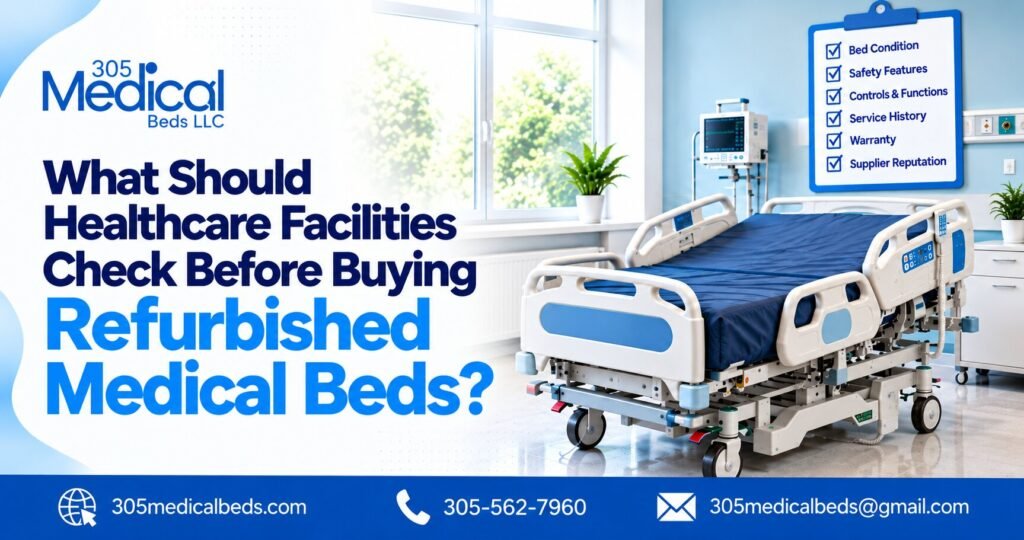
Healthcare facilities must balance patient safety, equipment reliability, operational requirements, and budget constraints when purchasing medical beds. For hospitals, nursing facilities, rehabilitation centers, and long-term care providers, refurbished medical beds can be an option worth evaluating when expanding capacity or replacing aging equipment.
However, purchasing refurbished hospital beds requires more than comparing prices. Healthcare administrators and procurement teams should evaluate the bed’s structural condition, electrical functions, safety features, refurbishment quality, maintenance history, replacement parts, and supplier support before making a purchasing decision.
A properly evaluated refurbished medical bed may help healthcare facilities manage equipment costs while meeting their patient care requirements. In this guide, we explain the most important factors to consider before purchasing refurbished medical beds and how to make a more informed buying decision.
Why Do Healthcare Facilities Consider Refurbished Medical Beds?
Healthcare facilities often need to expand patient capacity, replace aging equipment, or maintain reliable equipment availability without exceeding their budgets. Purchasing new medical beds for every replacement or expansion can represent a significant capital investment.
Refurbished medical beds may provide an alternative, depending on the equipment model, condition, refurbishment process, and supplier. Some refurbished beds retain features such as adjustable positioning, electronic controls, integrated side rails, and height adjustment.
However, the features available vary by manufacturer and model. Healthcare facilities should verify the specifications of each bed rather than assume that all refurbished models provide the same capabilities.
Before comparing prices, procurement teams should identify the facility’s clinical requirements, expected usage, patient population, and maintenance capabilities. These factors help determine whether a particular refurbished medical bed is suitable for the intended setting.
1. Check the Bed’s Overall Condition and Structural Integrity
The physical condition of a medical bed is one of the first things healthcare facilities should evaluate before purchasing refurbished equipment.
Medical beds may experience wear from repeated adjustments, patient transfers, transportation, cleaning, and routine use. Refurbishment should address identified defects rather than simply improve the bed’s appearance.
During an inspection, examine the following components:
- Bed frame: Look for cracks, bends, corrosion, damaged welds, or other signs of structural deterioration.
- Bed deck: Check for damaged sections, loose components, and uneven surfaces that could affect stability.
- Fasteners and joints: Inspect accessible bolts, joints, and attachment points for looseness or damage.
- Moving components: Check for unusual resistance, excessive movement, or visible damage during adjustment.
- Finish and surfaces: Look for damaged coatings, exposed materials, or areas that may be difficult to clean.
Healthcare facilities should request an inspection record documenting the bed’s condition and any repairs completed during refurbishment.
A bed that looks clean and attractive is not necessarily mechanically sound. Structural integrity should be verified before the equipment is approved for clinical use.
2. Test Electrical Functions, Motors, and Controls
Electric medical beds rely on motors, electrical components, and control systems to adjust the patient’s position and the bed’s height. These functions should be tested before the equipment is accepted.
The exact functions available depend on the bed model. Some beds offer head and foot positioning, height adjustment, Trendelenburg positioning, or additional specialized functions.
During the evaluation, ask the supplier to demonstrate every advertised function.
Check that:
- The bed raises and lowers smoothly throughout its intended operating range.
- Head and foot sections adjust correctly where these features are available.
- Hand controls and staff controls respond consistently.
- Buttons, cables, and connectors show no visible damage.
- Motors operate without unusual noises, interruptions, or excessive vibration.
- The power cord and electrical connections are intact.
- Emergency or backup functions operate as specified by the manufacturer, where applicable.
Facilities should also request documentation of relevant electrical safety testing and servicing. Testing should be performed by appropriately qualified personnel using procedures suitable for the equipment.
Do not approve a bed for patient use solely because its motors operate. The equipment must also meet the applicable safety requirements and manufacturer specifications for its intended environment.
3. Inspect Side Rails, Brakes, Wheels, and Safety Features
Safety-related components require careful attention because they can affect patient transfers, bed movement, and daily clinical workflows.
Start by inspecting the side rails, if fitted. Check for damage, secure attachment, smooth operation, and reliable locking mechanisms. Rails should operate according to the manufacturer’s instructions and be suitable for the intended patient and mattress configuration.
Healthcare facilities should also evaluate the following features.
Brakes and casters: Confirm that the braking system engages properly and that the wheels move and lock as specified. Inspect the casters for damage, excessive wear, or restricted movement.
Height adjustment: Verify that the bed reaches its intended positions without unexpected movement or instability.
Positioning controls: Ensure that the controls function correctly and that the bed responds predictably to adjustments.
Pinch and entrapment hazards: Assess potential gaps around the mattress, rails, and moving sections. The suitability of these spaces depends on the bed design, mattress dimensions, and patient population.
Emergency features: Where fitted, verify the operation of emergency release mechanisms and other model-specific safety functions.
Patient safety also depends on how a bed is configured and used. Facilities should follow the manufacturer’s instructions, applicable safety guidance, and their own clinical risk assessment when selecting bed rails and other accessories.
4. Verify the Refurbishment Process and Maintenance History
Not all refurbished medical beds undergo the same level of inspection or repair. One supplier may perform basic cleaning and limited repairs, while another may provide more extensive component replacement, functional testing, and documented quality checks.
Healthcare facilities should understand exactly what refurbishment includes before purchasing.
Ask the supplier:
- Which components were inspected, repaired, or replaced?
- Were damaged or worn parts replaced with compatible components?
- Were electrical and mechanical functions tested after servicing?
- Is there a written inspection or refurbishment report?
- Is the previous maintenance history available?
- Are any known defects or limitations disclosed?
- Has the bed been evaluated against the manufacturer’s specifications?
Where available, request serial numbers, model information, service records, and details of replacement components.
A documented refurbishment process makes it easier for procurement teams to assess the equipment and compare suppliers fairly.
Avoid relying on general descriptions such as “fully refurbished” without supporting documentation. The specific work completed and the tests performed are more useful than a label alone.
5. Check Mattress Compatibility and Infection Control
A medical bed and its mattress should be evaluated as a compatible system. A mattress that is unsuitable for the bed can affect positioning, comfort, safety, and the performance of certain bed features.
Before purchasing, verify the recommended mattress dimensions, thickness, type, and compatibility with the bed model. Consider whether the mattress is designed for the intended patient population and clinical setting.
Facilities should also review the condition of the mattress and any supplied accessories.
Check for:
- Tears, punctures, or damaged covers.
- Signs of moisture penetration or contamination.
- Damaged seams, zippers, or closures.
- Compatibility with the bed deck and side rails.
- Appropriate cleaning and disinfection instructions.
- Documentation of cleaning or replacement where applicable.
A mattress cover that appears clean may still have damage that is not immediately visible. Facilities should follow appropriate inspection procedures and replace components that cannot be safely cleaned or verified.
The supplier should explain how the bed and included accessories were cleaned and prepared before delivery. Healthcare facilities must also apply their own infection prevention and equipment acceptance procedures before placing refurbished equipment into service.
6. Confirm the Manufacturer, Model, and Available Replacement Parts
Before purchasing refurbished medical beds, identify the exact manufacturer and model. This information helps healthcare facilities verify specifications, locate compatible accessories, and determine whether replacement parts and technical support are available.
For example, facilities evaluating Hill-Rom hospital beds should confirm the exact model rather than relying only on the manufacturer’s name. Different models may have different controls, dimensions, electrical requirements, accessories, and maintenance procedures.
Ask the supplier to provide:
- Manufacturer and model details.
- Serial number and equipment identification.
- Available technical documentation.
- Information about compatible mattresses and accessories.
- Availability of replacement components.
- Details of any modifications made during refurbishment.
- Information about service support for that model.
Older equipment may require components that are difficult to source. This can affect repair timelines and long-term maintenance costs.
Facilities should also determine whether replacement parts are appropriate for the specific model and whether their use is consistent with the manufacturer’s instructions and applicable requirements.
Checking parts availability before purchase can help prevent avoidable equipment downtime later.
7. Review Warranty Coverage and After-Sales Support
Warranty terms can differ significantly between suppliers and refurbished medical bed models. Healthcare facilities should review the written terms carefully rather than assuming that refurbished equipment includes the same coverage as new equipment.
Important questions include:
- How long does the warranty last?
- Which mechanical and electrical components are covered?
- Are motors, control systems, and replacement parts included?
- Are labor and service visits covered?
- What exclusions or limitations apply?
- How are warranty claims submitted?
- Is technical support available if a bed stops functioning?
- What are the expected repair and replacement procedures?
Facilities should also clarify delivery arrangements, installation responsibilities, inspection requirements, and the process for reporting damage or missing components.
After-sales support is particularly important for facilities that depend on their beds for daily operations. A lower purchase price may offer limited value if repairs are difficult to arrange or replacement parts are unavailable.
Documented warranty coverage and clear support arrangements help procurement teams evaluate the supplier’s overall offering.
8. Evaluate Cleaning, Disinfection, and Documentation Requirements
Medical beds are used in environments where infection prevention and environmental cleaning are essential. Before accepting refurbished equipment, facilities should establish whether it can be cleaned and maintained according to the requirements of the intended clinical setting.
Request information about the cleaning products and procedures compatible with the bed’s surfaces, mattress, controls, and accessories. Some cleaning chemicals may damage particular materials or components if used incorrectly.
Healthcare facilities should also check that:
- Cleaning instructions are available.
- Required surfaces and components can be accessed for cleaning.
- No visible contamination or unexplained residue remains.
- Electrical and mechanical components have not been damaged by cleaning.
- Relevant refurbishment and inspection documentation is supplied.
The receiving facility should conduct its own inspection and follow its infection prevention protocols before introducing the equipment into patient care.
Where applicable, procurement teams should also review electrical safety documentation, service records, equipment identification, and any other records required by their policies or local regulations.
9. Compare the Total Cost of Ownership, Not Just the Purchase Price
Price is an important factor when purchasing refurbished medical beds, but the initial cost does not represent the entire investment.
A bed with a lower purchase price may require additional servicing, replacement parts, accessories, or transportation expenses. Another model may cost more initially but better meet the facility’s operational requirements.
To compare options fairly, calculate the expected total cost of ownership over a defined period.
Consider these expenses:
- Initial purchase price.
- Delivery and installation.
- Inspection and acceptance testing.
- Required mattresses and accessories.
- Preventive maintenance.
- Expected replacement parts and repairs.
- Staff training where needed.
- Potential downtime and replacement arrangements.
For example, a procurement team comparing two offers should assess not only the quoted prices but also the included accessories, warranty coverage, refurbishment documentation, and expected servicing requirements.
Use written supplier quotations and realistic maintenance estimates wherever possible. Avoid assuming that every refurbished bed will have lower long-term costs than a new bed; the result depends on the model, condition, usage, and support available.
A total-cost comparison helps healthcare facilities make purchasing decisions based on value, reliability, and operational suitability.
10. Make Sure the Bed Meets the Facility’s Clinical Requirements
A refurbished medical bed should be selected according to the patients and clinical environment it will serve. A bed suitable for a general hospital room may not meet the requirements of an intensive care unit, bariatric care setting, rehabilitation facility, or long-term care environment.
Before placing an order, identify the required bed functions and compare them with the specifications of the proposed model.
Consider the following questions:
- What patient population will use the bed?
- What weight capacity is required?
- What mattress type and dimensions are appropriate?
- Are specialized positioning functions needed?
- Will the bed fit comfortably within the room and allow safe staff access?
- Are the controls suitable for the intended clinical workflow?
- Are compatible accessories available?
- Can the facility maintain and service the equipment?
For specialized beds, such as ICU or bariatric models, verify the exact specifications and intended use. Weight capacity, positioning features, and accessory compatibility should never be assumed based on appearance alone.
Facilities should involve relevant clinical, biomedical engineering, maintenance, and procurement staff in the evaluation where appropriate.
11. Use a Pre-Purchase Inspection Checklist
A standardized checklist can help healthcare facilities compare multiple refurbished medical beds and ensure that important details are not overlooked.
Before approving a purchase, review the following items:
- Manufacturer, model, and serial number verified.
- Bed frame and deck inspected for structural damage.
- Motors and electrical functions tested.
- Controls, cables, and power connections inspected.
- Brakes, casters, and moving components checked.
- Side rails and locking mechanisms inspected where fitted.
- Mattress dimensions and compatibility confirmed.
- Mattress condition and cleaning requirements reviewed.
- Refurbishment report and available maintenance records received.
- Replacement parts and accessories availability confirmed.
- Warranty terms and after-sales support reviewed.
- Delivery, installation, and acceptance responsibilities agreed.
- Applicable safety and regulatory documentation reviewed.
- Total cost of ownership compared with alternative options.
- Final inspection and approval process established.
This checklist should be adapted to the equipment model, the facility’s clinical requirements, and applicable regulations. Any unresolved safety concern should be addressed before the bed is accepted for patient use.
Refurbished vs. New Medical Beds: What Should Healthcare Facilities Consider?
Both new and refurbished medical beds may be suitable for healthcare facilities, depending on the clinical requirements, budget, equipment condition, and available support.
| Factor | Refurbished Medical Beds | New Medical Beds |
|---|---|---|
| Initial purchase cost | May be lower, depending on model and condition | Often higher for comparable models |
| Equipment condition | Depends on prior use and refurbishment quality | Generally unused when supplied as new |
| Features | Depends on the original model and included components | Depends on the selected model and configuration |
| Warranty | Varies by supplier and agreement | Varies by manufacturer and purchase terms |
| Parts availability | Must be checked, especially for older models | Must still be verified for the selected model |
| Documentation | Refurbishment and service records should be reviewed | New equipment documentation should be reviewed |
| Best evaluation approach | Verify condition, repairs, testing, and support | Verify specifications, warranty, and suitability |
Neither option is automatically the best choice for every facility. Procurement teams should compare specific models and written quotations, paying particular attention to safety, reliability, maintenance, and long-term operational needs.
Frequently Asked Questions About Refurbished Medical Beds
Are refurbished medical beds suitable for hospitals?
Refurbished medical beds may be suitable for hospital use when the specific model meets the facility’s clinical requirements and applicable safety standards. Healthcare facilities should verify the bed’s condition, refurbishment documentation, functional testing, and service support before approving it for patient use.
What should I inspect before buying a refurbished hospital bed?
Inspect the frame, bed deck, motors, electrical controls, brakes, casters, side rails, mattress compatibility, and other model-specific safety features. Also review maintenance records, refurbishment documentation, warranty coverage, and replacement parts availability.
Are refurbished medical beds cheaper than new beds?
Refurbished medical beds may have a lower initial purchase price than comparable new models. However, the actual savings depend on the bed’s condition, included components, warranty, maintenance requirements, and expected service life. Compare total costs rather than purchase price alone.
How can I verify the quality of a refurbished medical bed?
Ask for the refurbishment report, available maintenance history, details of replaced components, and records of relevant functional and safety testing. Have qualified personnel inspect the equipment according to the facility’s acceptance procedures before it is placed into service.
What is the difference between a used and a refurbished medical bed?
A used medical bed has previously been in service and may be sold with varying levels of inspection or repair. A refurbished medical bed should have undergone a defined process of inspection, cleaning, repair, or component replacement. The exact scope varies by supplier, so buyers should request written details of the work performed.
Should healthcare facilities buy refurbished ICU beds?
Refurbished ICU beds may be an option for facilities with specialized equipment needs, but the decision requires careful evaluation. Confirm the exact model, positioning functions, weight capacity, compatibility with required accessories, maintenance support, and applicable clinical and safety requirements.
What documents should a supplier provide with refurbished medical beds?
Depending on the equipment and applicable requirements, useful documents may include model and serial number information, refurbishment reports, available service history, functional test records, electrical safety documentation, operating instructions, warranty terms, and details of replacement components.
How important is the warranty when buying refurbished medical beds?
Warranty coverage can help clarify responsibility for certain repairs and component failures. Facilities should review the coverage period, exclusions, labor terms, parts coverage, and claims process. A warranty should be considered alongside the bed’s condition, documentation, and available technical support.
How often should refurbished medical beds be maintained?
Maintenance frequency depends on the manufacturer, model, usage, facility policies, and applicable requirements. Follow the manufacturer’s instructions and establish a documented preventive maintenance schedule with appropriately qualified personnel.
Can refurbished medical beds be used in long-term care facilities?
They may be appropriate when the equipment meets the facility’s needs and has been properly evaluated. Facilities should consider patient mobility, bed height, positioning requirements, mattress compatibility, safety features, cleaning procedures, and the availability of maintenance support.
Conclusion
Buying refurbished medical beds requires a structured evaluation of safety, condition, functionality, documentation, and long-term support. Healthcare facilities should look beyond the purchase price and confirm that each bed is suitable for its intended clinical environment.
Before making a decision, inspect the bed’s structural components, test its electrical and mechanical functions, review refurbishment records, verify mattress compatibility, and confirm the availability of replacement parts and warranty support. A consistent inspection process can help procurement teams compare suppliers and identify potential issues before delivery.
For hospitals, nursing facilities, rehabilitation centers, and other healthcare providers, the goal is to select medical beds that meet patient care requirements while supporting reliable day-to-day operations.
At 305MedicalBeds.com, healthcare facilities can explore available medical bed options and evaluate the specifications of individual models to determine which equipment best matches their needs. Always confirm current inventory, refurbishment details, included accessories, and warranty terms before purchasing.