
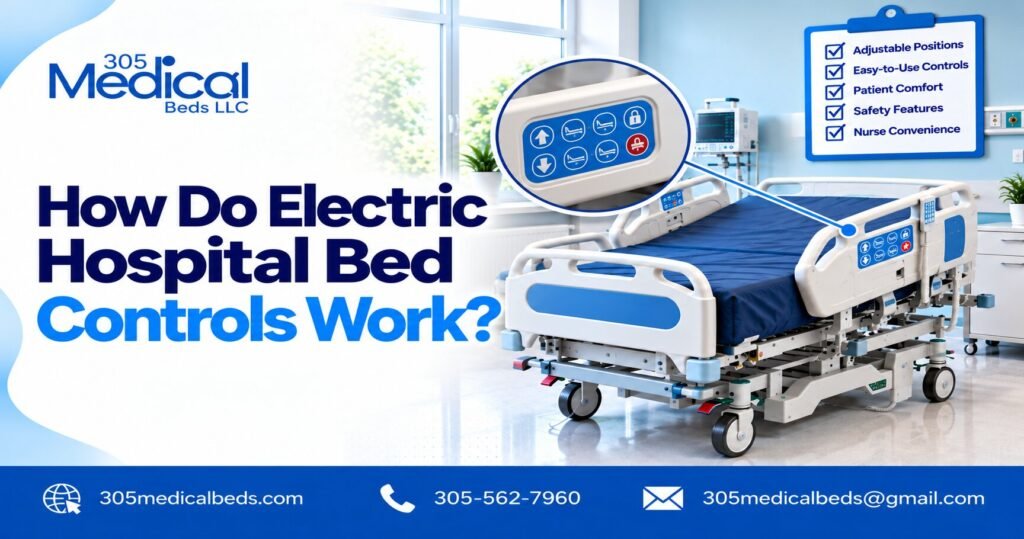
Electric hospital beds are designed to make patient positioning, bed height adjustment, and everyday care tasks easier for patients and healthcare professionals. Unlike manual hospital beds that rely on hand cranks, electric hospital beds use powered mechanisms operated through buttons, hand controls, or integrated control panels.
Understanding how electric hospital bed controls work can help hospitals, nursing facilities, rehabilitation centers, and home-care providers choose equipment that meets their needs. It can also help staff identify basic operating issues and understand which features are available on a particular bed model.
Electric hospital bed controls vary by manufacturer and model. Some beds provide basic head and foot positioning, while advanced hospital and intensive care beds may offer additional positioning functions, staff controls, and specialized safety features.
In this guide, we explain how electric hospital bed controls operate, the functions they provide, common control problems, and what healthcare facilities should consider when selecting an electric hospital bed.
What Are Electric Hospital Bed Controls?
Electric hospital bed controls are the buttons, switches, or electronic interfaces used to operate a bed’s powered adjustment mechanisms. They allow authorized users to change the bed’s position without manually turning a crank.
Most electrically adjustable hospital beds use electric motors connected to mechanical components that raise, lower, or reposition different sections of the bed. When a user presses a control button, the system activates the appropriate mechanism to perform the requested movement.
Depending on the model, controls may be available through:
- A handheld patient control.
- A staff control panel.
- Controls integrated into the bed’s side rails.
- A footboard control panel.
- A pendant or remote control connected to the bed.
Some advanced beds also include electronic locking functions, position indicators, or additional controls for specialized clinical applications.
The exact arrangement depends on the manufacturer and the intended use of the bed.
How Do Electric Hospital Bed Controls Work?
Electric hospital bed controls operate through a combination of electrical components, motors, mechanical linkages, and control switches.
When a user presses a button, the control system sends a command to the relevant motor or actuator. The motor then moves the associated mechanism, changing the position of the bed or one of its sections.
For example, pressing the head-up button may activate an actuator that raises the backrest. Pressing the height-adjustment button may activate a different mechanism that raises or lowers the entire bed frame.
The process generally involves four main components.
1. Control Buttons or Panels
The control interface allows the patient or healthcare professional to request a specific movement. Each button is assigned to a particular function, such as raising the head section or adjusting the bed height.
2. Electrical Control System
The control system interprets the button input and directs power to the appropriate motor. Depending on the design, it may also manage control locking, movement limits, or other protective functions.
3. Electric Motors and Actuators
Motors and linear actuators convert electrical energy into mechanical movement. They move the bed’s adjustable sections or lifting mechanisms according to the selected function.
4. Mechanical Components
The bed frame, joints, linkages, and lifting mechanisms transfer the actuator’s movement to the relevant section of the bed.
Together, these components allow users to adjust the bed with minimal physical effort compared with manual adjustment systems.
What Functions Can Electric Hospital Bed Controls Operate?
The functions available depend on the bed’s design and configuration. Before purchasing an electric hospital bed, healthcare facilities should verify which adjustments are included in the specific model.
1. Head and Backrest Adjustment
Head and backrest controls raise or lower the upper section of the bed. This allows users to adjust the patient’s upper-body position for comfort, meals, reading, examinations, or other care activities as appropriate.
Some beds provide a wide range of backrest positions, while others offer more limited adjustment.
Healthcare staff should follow the patient’s care plan and the manufacturer’s instructions when selecting a position.
2. Knee and Foot Section Adjustment
Some electric hospital beds allow the knee or foot section to move independently or in coordination with the backrest.
This feature can help staff adjust the patient’s posture and provide different positioning options. The available movements vary by model, so users should check the control labels and operating manual before making adjustments.
3. Bed Height Adjustment
Height controls raise or lower the entire bed frame. Lowering the bed can help with certain patient transfers and may support facility-specific fall-prevention procedures. Raising the bed can make some nursing tasks and examinations easier for staff.
The appropriate bed height depends on the patient, the care activity, and the facility’s safety procedures.
4. Trendelenburg and Reverse Trendelenburg Positioning
Certain hospital beds offer Trendelenburg and reverse Trendelenburg positioning.
Trendelenburg positioning tilts the bed so the patient’s head is lower than the feet. Reverse Trendelenburg tilts it in the opposite direction.
These functions are generally found on beds designed for clinical environments where specialized positioning is required. They are not available on every electric hospital bed.
Such positions should only be used when appropriate for the clinical situation and in accordance with professional guidance and the manufacturer’s instructions.
5. Bed Position Memory and Preset Functions
Some advanced beds offer preset positions or programmable controls that help staff move the bed into predefined configurations.
Depending on the model, these may include a chair-like position, a flat position, or other manufacturer-defined settings.
Preset functions can simplify routine adjustments, but users should verify that the intended movement is safe and suitable for the patient before activating it.
6. Lockout Controls
Some electric hospital beds include control-locking features that restrict selected functions. These may be used to prevent unintended adjustments or limit access to certain controls.
Lockout arrangements differ across models. Staff should understand which controls can be locked, how to activate or deactivate the lock, and how the feature is intended to be used.
What Is the Difference Between Patient Controls and Staff Controls?
Electric hospital beds may provide separate controls for patients and healthcare professionals.
| Feature | Patient Controls | Staff Controls |
|---|---|---|
| Typical location | Handheld remote or accessible side-rail panel | Integrated staff panel or designated control interface |
| Main purpose | Allow permitted bed adjustments | Support clinical care and bed management |
| Common functions | Head and foot positioning, where available | Height adjustment and additional model-specific functions |
| Access | Designed for appropriate patient access | May include restricted or lockable functions |
| Availability | Depends on bed configuration | Depends on bed model and intended setting |
Not every bed has separate patient and staff controls. Some models use a shared interface, while others provide multiple control locations.
Healthcare facilities should evaluate control placement, readability, ease of use, and the ability to restrict functions where necessary. These considerations can be particularly important in hospitals, rehabilitation facilities, and long-term care environments.
How Do Electric Hospital Bed Controls Improve Patient Care?
Electric controls can support patient care by making bed adjustments easier and reducing the need for manual cranking. Their benefits depend on the bed’s capabilities, how it is used, and the needs of the patient and care team.
Easier Position Adjustment
Powered controls allow users to adjust the bed with the press of a button. This can make routine positioning more convenient for patients who can safely operate the controls and for staff performing care tasks.
Support for Healthcare Staff
Height-adjustable beds can help staff position the bed at a more suitable working height during certain activities. This may support safer working practices when combined with appropriate patient-handling procedures.
More Convenient Bed Management
When several adjustments are powered, staff may be able to reposition the bed more efficiently than with a manual system.
Greater Independence for Some Patients
Patients who have the ability and authorization to use the controls may be able to make certain comfort-related adjustments without requesting assistance for every movement.
However, not all patients can safely operate electric controls. Staff should assess individual needs and provide appropriate supervision or assistance.
Access to Specialized Positioning
Advanced models may offer positioning features designed for particular clinical workflows. Healthcare facilities should select these features according to their intended use rather than assuming that every electric bed provides the same capabilities.
What Should You Check Before Buying an Electric Hospital Bed?
Choosing an electric hospital bed involves more than confirming that it has powered controls. Buyers should evaluate its features, condition, compatibility, maintenance requirements, and suitability for the intended environment.
1. Verify the Available Functions
Confirm whether the bed offers head and foot adjustment, height adjustment, Trendelenburg positioning, preset positions, or other required functions.
Do not assume that every electric bed includes all these features. Request the model’s specifications and demonstrate the functions before purchase.
2. Test Every Control
Ask the supplier to demonstrate each available control. Confirm that buttons respond consistently and that the relevant sections move smoothly through their intended operating ranges.
Look for damaged buttons, worn control labels, frayed cables, loose connectors, or other visible defects.
3. Check Motors and Actuators
Electric motors and actuators are important parts of the adjustment system. Ask whether they have been inspected and tested, especially when considering used or refurbished hospital beds.
Unusual noises, intermittent movement, or failure to complete an adjustment may indicate that further inspection is needed.
4. Review Electrical Safety
Check the condition of the power cord, plug, connectors, and accessible electrical components. Request relevant electrical safety testing documentation where applicable.
Electrical inspections and repairs should be carried out by appropriately qualified personnel in accordance with the manufacturer’s instructions and applicable requirements.
5. Understand the Control-Locking System
If the bed includes lockout functions, confirm how they operate and which movements they restrict.
This is important for facilities that need to manage access to particular controls as part of their patient-care procedures.
6. Confirm Mattress and Accessory Compatibility
The mattress, side rails, and other accessories should be compatible with the exact bed model.
Incorrect dimensions or incompatible accessories can affect positioning and may create safety concerns. Verify the manufacturer’s specifications before purchasing replacements or additional components.
7. Ask About Maintenance and Replacement Parts
Find out whether compatible motors, actuators, control panels, cables, and other replacement components are available.
For refurbished beds, request information about the work completed during refurbishment and any available service records.
8. Review Warranty and Technical Support
Confirm the warranty period, covered components, exclusions, and repair process. Ask whether the supplier can provide technical support if the control system stops working.
Clear support arrangements can help healthcare facilities plan maintenance and minimize avoidable equipment downtime.
Common Electric Hospital Bed Control Problems
Electric hospital bed controls can experience problems due to electrical faults, damaged cables, worn components, mechanical obstructions, or other equipment issues.
Understanding common symptoms can help staff report problems accurately and arrange appropriate servicing.
The Bed Does Not Move When a Button Is Pressed
Possible causes include a disconnected power supply, an activated control lock, a damaged cable, or a fault in the control system.
Check only the basic items permitted by the operating manual. If the problem continues, remove the bed from use when its safety or functionality is in question and contact qualified service personnel.
The Bed Moves Slowly or Stops Unexpectedly
Slow or interrupted movement may indicate an actuator problem, an electrical issue, a mechanical obstruction, or a condition requiring service.
Do not continue operating the bed if movement is abnormal or the bed appears unstable. Follow the manufacturer’s troubleshooting instructions.
The Hand Control Does Not Respond
A faulty hand control, damaged cable, loose connection, or control-lock setting may prevent the bed from responding.
Check the instructions for the specific model and avoid opening the control unit or attempting electrical repairs unless qualified and authorized to do so.
The Controls Work Intermittently
Intermittent operation may be associated with damaged wiring, worn switches, faulty connections, or another electrical or mechanical issue.
The bed should be assessed by qualified personnel before continued use if the problem could affect patient safety.
A Motor Makes Unusual Noises
Unusual grinding, clicking, or excessive noise may indicate a mechanical or motor-related issue. The cause cannot be determined from the sound alone.
Stop using the affected function if appropriate, follow the manufacturer’s guidance, and arrange a professional inspection.
Important: Never bypass a safety mechanism, force a powered bed section to move, or perform unauthorized electrical repairs. Follow the manufacturer’s instructions and facility procedures whenever a bed develops a fault.
Electric vs. Manual Hospital Bed Controls
Electric and manual hospital beds differ in how their adjustment mechanisms are operated.
| Feature | Electric Hospital Bed | Manual Hospital Bed |
|---|---|---|
| Adjustment method | Electric motors and controls | Hand cranks or mechanical controls |
| Physical effort | Generally less effort for powered adjustments | Requires manual operation |
| Power requirement | Usually requires an electrical supply, depending on model | Usually does not require electricity for adjustment |
| Available functions | May include several powered positioning functions | Depends on the mechanical design |
| Maintenance | Includes electrical and mechanical components | Primarily depends on mechanical components |
| Purchase cost | Varies by features, model, and condition | Varies by design and configuration |
Electric hospital beds can offer greater convenience for frequent positioning adjustments, while manual beds may be suitable for settings with simpler requirements.
The right option depends on the patient’s needs, the facility’s workflow, the required features, the available budget, and the ability to maintain the equipment.
Frequently Asked Questions
How do electric hospital bed controls work?
Electric hospital bed controls send commands to a control system, which activates motors or actuators to adjust the bed’s height or position. The available movements depend on the bed’s design and configuration.
Do electric hospital beds need to be plugged in?
Many electric hospital beds require an electrical supply for powered adjustments. Some models may include battery backup or other power-related features. Check the manufacturer’s specifications to confirm how the specific bed operates.
Can patients operate electric hospital bed controls themselves?
Some patients can safely operate designated controls to adjust their position. Suitability depends on their abilities, the bed design, and the care plan. Patients who cannot use the controls safely may require assistance.
What is the difference between a fully electric and a semi-electric hospital bed?
A fully electric hospital bed typically uses powered controls for multiple adjustments, which may include bed height and head or foot positioning. A semi-electric bed generally powers some adjustments while requiring manual operation for others. Exact configurations vary by model.
Why are my electric hospital bed controls not working?
Possible causes include a disconnected power supply, an activated control lock, damaged wiring, a faulty hand control, or a motor or control-system problem. Follow the manufacturer’s basic troubleshooting instructions and contact qualified service personnel if the problem persists.
Are electric hospital bed controls universal?
No. Control panels, hand controls, connectors, functions, and electrical specifications vary between manufacturers and models. Replacement controls should be verified as compatible with the exact bed.
Can electric hospital bed controls be repaired?
Some control-system components can be repaired or replaced, depending on the model and the nature of the fault. Repairs should follow the manufacturer’s service requirements and be performed by qualified personnel.
What should I check when buying a refurbished electric hospital bed?
Inspect the bed’s mechanical condition, test the available powered functions, review electrical safety documentation, confirm mattress and accessory compatibility, and ask for refurbishment records, warranty terms, and information about replacement parts.
Do all electric hospital beds have Trendelenburg positioning?
No. Trendelenburg and reverse Trendelenburg functions are available only on models designed to provide them. Verify the exact specifications before purchasing a bed for a clinical setting that requires specialized positioning.
How often should electric hospital beds be serviced?
Maintenance intervals depend on the manufacturer, model, frequency of use, facility policies, and applicable requirements. Follow the manufacturer’s maintenance schedule and keep records of inspections, repairs, and servicing.
Conclusion
Electric hospital bed controls use electrical systems, motors, actuators, and mechanical components to make bed positioning easier and more convenient. Depending on the model, these controls may operate the head section, foot section, bed height, and specialized positioning functions.
For healthcare facilities, understanding these controls is important when selecting, operating, and maintaining medical beds. Buyers should verify the available functions, test the controls, inspect electrical components, confirm accessory compatibility, and review maintenance and warranty arrangements before making a purchase.
Whether you are equipping a hospital, nursing facility, rehabilitation center, or home-care environment, selecting a bed with suitable controls can help support daily care requirements.
Explore the available medical bed options at 305 Medical Beds to compare relevant models and confirm which features match your facility’s needs. Always verify current availability, specifications, and warranty terms before purchasing.