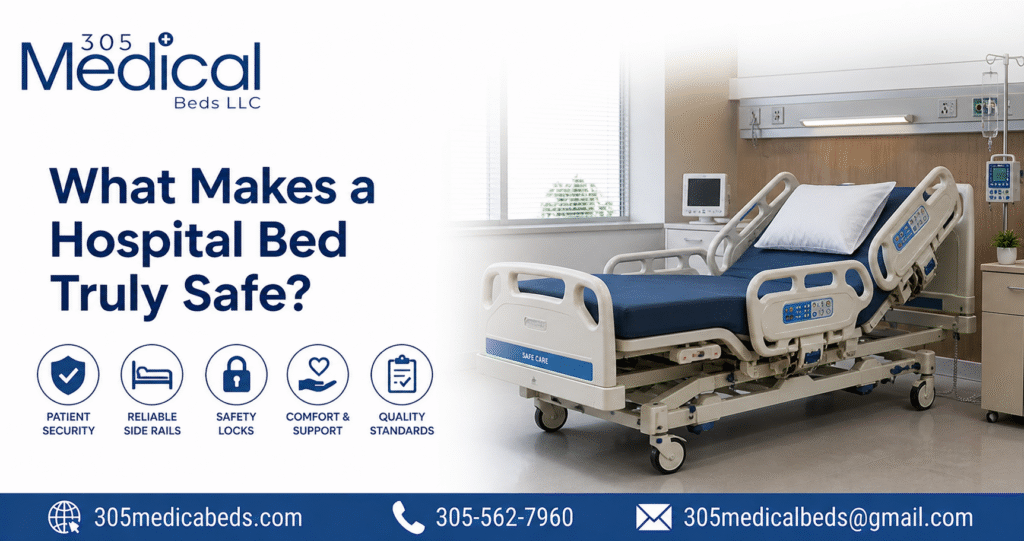
What Makes a Hospital Bed Truly Safe?
Quick Answer A safe hospital bed includes side rail entrapment protection, low-height fall prevention, appropriate weight capacity, a pressure-relief mattress, lockable casters, and surfaces designed for infection control — all meeting FDA 510(k) clearance standards. The right combination depends on the individual patient’s needs. A hospital bed is not just a place to sleep. For patients recovering from surgery, managing chronic illness, or receiving long-term care, it is one of the most critical pieces of medical equipment in the room — and its hospital bed safety features can make a real difference in outcomes. At 305 Medical Beds, we believe every patient deserves a bed that is matched precisely to their safety needs. Think about it: a patient may spend 90% of their day in that bed. Yet most people — caregivers, families, even some healthcare buyers — rarely stop to ask what actually makes a hospital bed safe. Is it the side rails? The mattress? The height adjustment? The answer is all of the above, and more. In this guide, we break down every key hospital bed safety feature you need to understand — whether you are purchasing beds for a care facility, setting up a home care environment, or making a careful decision for a family member. Key Takeaways The 8 Hospital Bed Safety Features That Matter Most Before diving deep into each one, here is a structured overview of the key hospital bed safety features covered in this guide: 700K+ Patient falls in US hospitals each year (AHRQ) 09 FDA-defined entrapment zones on every hospital bed 2.5M Pressure injuries treated annually in US care settings (NCBI) 30% Falls that result in injury, many from beds (CDC) 1. Side Rail Design and Entrapment Prevention Side rails are among the most visible and debated hospital bed safety features. A safe hospital bedside rail system prevents accidental falls while simultaneously protecting patients from entrapment — a documented and serious hazard recognized by the FDA. The FDA identifies 9 entrapment zones on a hospital bed — areas between the mattress, side rails, bed frame, headboard, and footboard where a patient’s body, head, neck, or limbs can become dangerously trapped. Every FDA-cleared hospital bed must be designed to minimize risk across all 9 zones. Mattress-to-rail gaps exceeding approximately 1 inch are considered a significant entrapment hazard. What to look for in safe side rails: 2. Height Adjustment and Fall Prevention One of the most underappreciated hospital bed safety features is the bed’s ability to move vertically. A bed that lowers to within 7–9 inches of the floor dramatically reduces injury severity when a patient does fall — a configuration clinically referred to as a “low bed” or “ultra-low” position. Falls from hospital beds remain one of the most common preventable incidents in both clinical and home care settings. According to the Agency for Healthcare Research and Quality (AHRQ), over 700,000 patient falls occur in US hospitals annually, and approximately 30% result in some form of injury. Bed height is one of the most modifiable contributing factors. Key Height-Related Hospital Bed Safety Features: 3. Weight Capacity and Structural Integrity A hospital bed’s weight capacity is a fundamental safety specification — not a secondary consideration. Standard hospital beds are rated for 350–450 lbs. Bariatric hospital bed models are engineered to support 600–1,000 lbs or more, with reinforced frames that meet ASTM F3186 standards for bariatric medical equipment. Exceeding a bed’s rated weight capacity introduces three direct risks: frame failure or collapse, mattress compression that defeats pressure-relief design, and destabilized patient positioning that increases fall likelihood. As a general clinical guideline, the bed’s weight rating should exceed the patient’s actual body weight by at least 20%. Clinical Guideline Always select a hospital bed rated for at least 20% above the patient’s actual body weight. For a 350 lb patient, the minimum safe bed rating is 420 lbs. For bariatric care, choose beds certified to ASTM F3186 bariatric standards and confirm the entire support system — mattress, frame, and casters — is rated consistently. 4. Mattress Systems and Pressure Injury Prevention The mattress is not a separate consideration from the bed frame — it is an integrated part of the hospital bed safety system. Pressure injuries (also known as pressure ulcers or bedsores) affect approximately 2.5 million patients annually in US care settings, according to the National Center for Biotechnology Information (NCBI). The right mattress is the primary preventive defense. Foam Mattresses Standard pressure distribution. Best for mobile or lower-risk patients. Short-term recovery use. Alternating Pressure Air cells inflate and deflate cyclically, constantly shifting pressure points. Ideal for immobile or high-risk patients. Low Air Loss Releases a gentle air stream to manage skin moisture and reduce maceration. Critical for wound care patients. Lateral Rotation Tilts the patient side-to-side automatically. Aids respiratory function and prevents secretion pooling. Beyond type, the mattress must fit the bed frame precisely. Gaps exceeding approximately 1 inch between the mattress edge and the bed rails create entrapment hazards — a documented risk in the FDA’s Zone 6 and Zone 7 entrapment classifications. Always verify mattress-to-frame fit when combining components from different manufacturers. 5. Brake and Caster Systems A hospital bed that moves unexpectedly during a patient transfer is one of the leading causes of both patient injury and caregiver musculoskeletal harm. The brake system is a critical and often overlooked hospital bed safety feature. Central braking systems — where a single foot pedal locks all four casters simultaneously — are significantly safer than individual wheel brakes that require staff to crouch and engage each corner separately. In high-acuity or emergencies, the seconds saved by central braking are clinically meaningful. 6. Nurse Call and Monitoring Integration Modern hospital beds increasingly incorporate integrated technology designed to improve patient safety without creating additional burden for nursing staff. These medical bed safety technologies are especially important in facilities with high patient-to-nurse ratios. 7. Infection Control and Surface Materials Hospital-acquired infections (HAIs) affect approximately 1 in 31 hospital patients on any given day, according to the CDC’s HAI prevalence data. The design and materials of a hospital bed’s surfaces play a direct role in