
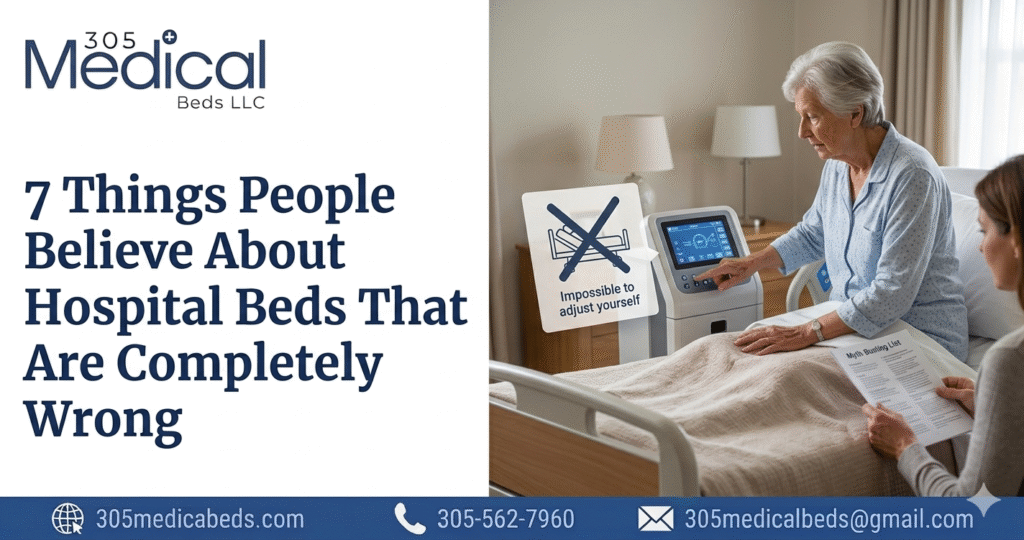
7 Things People Believe About Hospital Beds That Are Completely Wrong
After years of delivering hospital beds to patients, families, caregivers, and care facilities across South Florida, we’ve heard a lot of reasons why people hesitate. Some of those reasons are practical. Some are emotional. And some — more than we’d like — are based on information that is simply, demonstrably wrong. Wrong information about hospital beds has real consequences. It delays decisions that should have been made weeks earlier. It leads families to spend money they didn’t need to spend, or to avoid spending money that would have saved them far more. It keeps patients in uncomfortable, unsafe sleeping situations while the right equipment sits one phone call away. So let’s have an honest conversation about the seven hospital bed myths we encounter most often — and what the reality actually looks like. Myth 1: Hospital beds are only for people who are seriously ill or dying. This one lives in the cultural imagination more stubbornly than almost any other. The phrase “hospital bed” carries a weight that a regular adjustable bed doesn’t — it sounds clinical, final, serious. And so families delay, because using one feels like an admission that things are worse than they want to admit. But walk through who actually uses hospital beds at home, and the picture looks very different. Post-surgical patients recovering from hip or knee replacements — often people in their 50s and 60s who will be completely fine in twelve weeks — use them routinely because a regular bed makes recovery harder and riskier than it needs to be. People managing acid reflux, sleep apnea, and lower back pain use adjustable hospital beds because elevating the head of the bed makes sleep dramatically better. Pregnant women in the third trimester use them. Athletes recovering from sports injuries use them. A hospital bed is a positioning tool. It exists because the human body — in a wide range of conditions, temporary and chronic, mild and severe — functions better when it can be placed at angles a flat bed doesn’t allow. That’s it. The clinical appearance is a design feature from an era when medical equipment wasn’t meant to look like home furniture. The function is universal. The Reality Hospital beds are used by people recovering from routine surgeries, managing chronic conditions, caring for aging parents, and dealing with temporary injuries. Seriousness of illness is not a prerequisite. Needing better positioning is. Myth 2: Medicare won’t cover a hospital bed at home, that’s only for things you use in a hospital. This myth is expensive. We have had families come to us having already spent $2,000–$3,000 out of pocket on a hospital bed, only to find out during the conversation that they had a qualifying diagnosis and Medicare would have covered 80% of the cost. That’s a $1,600 check they didn’t need to write. Medicare Part B covers hospital beds as Durable Medical Equipment — DME — when prescribed by a physician for use in the home. This has been the case for decades. The program exists specifically because keeping patients at home, in appropriate equipment, costs the healthcare system less than keeping them in facilities. Medicare’s coverage of home DME is not a loophole or an exception. It is an intended benefit. The qualifying conditions are broader than most people expect: congestive heart failure, COPD, post-surgical recovery, severe arthritis, stroke, multiple sclerosis, ALS, stage 3 or 4 pressure ulcers, and more. If your doctor can document that a regular flat bed is medically unsafe or inadequate for your condition, that is the threshold for coverage. Medicare pays 80% of the approved amount. If you have a Medigap supplemental plan, it may cover the remaining 20% — bringing your out-of-pocket cost to zero. Before you pay anything out of pocket: Call a Medicare-enrolled DME supplier and have them verify your coverage. At 305 Medical Beds, we do this at no charge before any purchase. The five-minute call could save you thousands. The reality Medicare Part B covers hospital beds as DME for qualifying patients. Many common diagnoses qualify. Always check before purchasing — a local Medicare-enrolled supplier can verify your eligibility in minutes at no cost. The Reality Hospital beds are used by people recovering from routine surgeries, managing chronic conditions, caring for aging parents, and dealing with temporary injuries. Seriousness of illness is not a prerequisite. Needing better positioning is. Myth 3: Refurbished hospital beds are lower quality, you should always buy new. This belief costs families and facilities significant money with no corresponding benefit in safety or performance. It comes from a reasonable instinct — new things are better than used things — applied to a category where that instinct doesn’t hold. Hospital beds from manufacturers like Hill-Rom and Stryker are built to commercial-grade standards designed for years of continuous daily use in acute care settings. A Hill-Rom Versacare bed is not built to the same standard as a piece of consumer furniture. When these beds are retired from hospitals — often because the facility is upgrading to a newer model, not because anything is wrong with the bed — they have years of functional life remaining in them. A properly certified refurbished hospital bed goes through complete disassembly, deep cleaning to hospital infection-control standards, replacement of all wear components (motors, actuators, cables, pendant cords, brake pedals), fresh powder-coat paint on the frame, full electrical safety testing, and documented inspection before it reaches you. What you receive at the end of that process is a bed that performs identically to a new model, at 40–60% lower cost, with written documentation of everything that was done to it. The key word is “certified.” Not every seller who calls their beds “refurbished” has done this work. Ask for documentation. A serious supplier provides it without hesitation. A supplier who can’t provide it is selling you something different from what we’re describing. The Reality Certified refurbished hospital beds from reputable manufacturers perform equivalently to new, at 40–60% lower cost. Documentation of the refurbishment process