
Bringing a hospital bed into your home can dramatically improve comfort, safety, and recovery. But many families ask the same important question:
How Do You Actually Qualify for a Home Hospital Bed?
To qualify for a hospital bed at home, you typically need:
- A documented medical condition
- A doctor’s prescription
- Proof that a standard bed cannot meet medical needs
- A face-to-face medical evaluation
- Insurance approval (if using Medicare or private insurance)
Most insurance providers, including Medicare, require proof of medical necessity.
In Short:
A patient qualifies for a hospital bed at home when a doctor determines that special positioning, elevation, or safety features are medically necessary and cannot be achieved with a standard bed.
Why Medical Necessity Is Required
Insurance companies do not approve hospital beds for convenience. Approval is based on medical need.
You may qualify for a hospital bed at home if you:
- Require body positioning not possible in a regular bed
- Need head elevation greater than 30 degrees
- Have severe respiratory conditions
- Are at risk of pressure ulcers
- Need traction equipment attached to the bed
- Have limited mobility or fall risk
A physician must clearly document medical necessity.
Medicare Requirements to Qualify for a Hospital Bed at Home
If you are using Medicare, hospital beds fall under Durable Medical Equipment (DME).
To qualify under Medicare Part B, you must:
1. Have a Face-to-Face Evaluation
A doctor must examine you and document the need.
2. Receive a Written Prescription
The prescription must include:
- Diagnosis
- Medical reason for bed
- Type of hospital bed required
3. Use a Medicare-Approved Supplier
The supplier must accept Medicare assignment.
4. Meet Coverage Criteria
Medicare typically covers:
- Manual hospital beds
- Semi-electric beds (if medically necessary)
Luxury or full-electric beds may not be fully covered unless justified.
Conditions That May Help You Qualify
You may qualify for a hospital bed at home if you have:
- Chronic obstructive pulmonary disease (COPD)
- Congestive heart failure
- Severe arthritis
- Spinal cord injuries
- Neuromuscular diseases
- Risk of pressure sores
- Post-surgical recovery needs
- Limited mobility due to stroke
The key factor is whether positioning or adjustability is medically required.
Types of Hospital Beds and Qualification Differences
| Bed Type | Usually Covered? | Qualification Level |
|---|---|---|
| Manual Hospital Bed | Yes | Standard medical need |
| Semi-Electric Bed | Often | Must justify electric adjustment |
| Full-Electric Bed | Rarely | Requires strong medical justification |
| Bariatric Bed | Case-by-case | Based on weight and condition |
Insurance approval depends on documented medical necessity.
Private Insurance Requirements
If you are not using Medicare, private insurance providers often follow similar rules:
- Physician prescription required
- Medical necessity documentation
- Prior authorization
- Approved equipment supplier
Always verify:
- Coverage percentage
- Rental vs purchase options
- Co-pay requirements
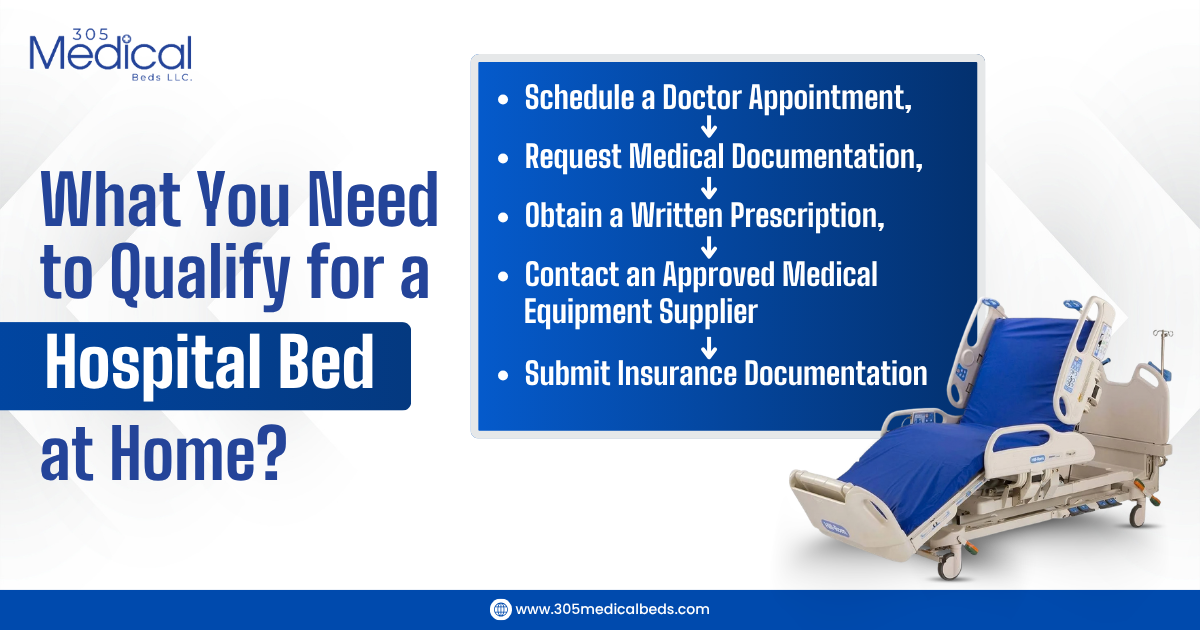
Steps to Qualify for a Hospital Bed at Home (Simple Process)
Here’s how to move forward:
Step 1: Schedule a Doctor Appointment
Discuss symptoms, mobility limitations, and sleeping challenges.
Step 2: Request Medical Documentation
Ensure the doctor clearly states why a standard bed is insufficient.
Step 3: Obtain a Written Prescription
The prescription must specify the type of bed needed.
Step 4: Contact an Approved Medical Equipment Supplier
Choose a licensed DME provider.
Step 5: Submit Insurance Documentation
Your supplier usually helps handle paperwork.
Common Reasons for Denial
Understanding denial risks helps prevent delays.
You may be denied if:
- No clear medical necessity is documented
- The condition is temporary without a strong justification
- The prescription lacks detail
- Supplier is not approved
- The request is for convenience only
Proper documentation dramatically improves approval chances.
Can You Rent Instead of Buy?
Yes. In many cases:
- Medicare rents hospital beds monthly
- After 13 months of continuous rental, ownership may transfer
- Rental is often more affordable upfront
Rental is common for short-term recovery needs.
Do You Need Additional Accessories to Qualify?
Sometimes.
Accessories such as:
- Pressure-relief mattresses
- Bed rails
- Trapeze bars
May require separate justification depending on the patient’s condition.
Each accessory must also meet medical necessity standards.
Summary:
To qualify for a hospital bed at home, you need:
- A qualifying medical condition
- Physician evaluation and prescription
- Proof that a regular bed is insufficient
- Insurance approval
- A certified medical equipment supplier
The most important factor is clear documentation of medical necessity.
Frequently Asked Questions
- Who qualifies for a hospital bed at home?
Patients who cannot safely or comfortably use a regular bed due to medical conditions, positioning needs, or mobility limitations may qualify. - Does Medicare cover semi-electric hospital beds?
Yes, if medically necessary and properly documented. - How long does approval take?
Approval can take a few days to a few weeks, depending on documentation and insurance processing time. - Can I qualify without insurance?
Yes, but you would pay out of pocket unless eligible for financial assistance programs.