
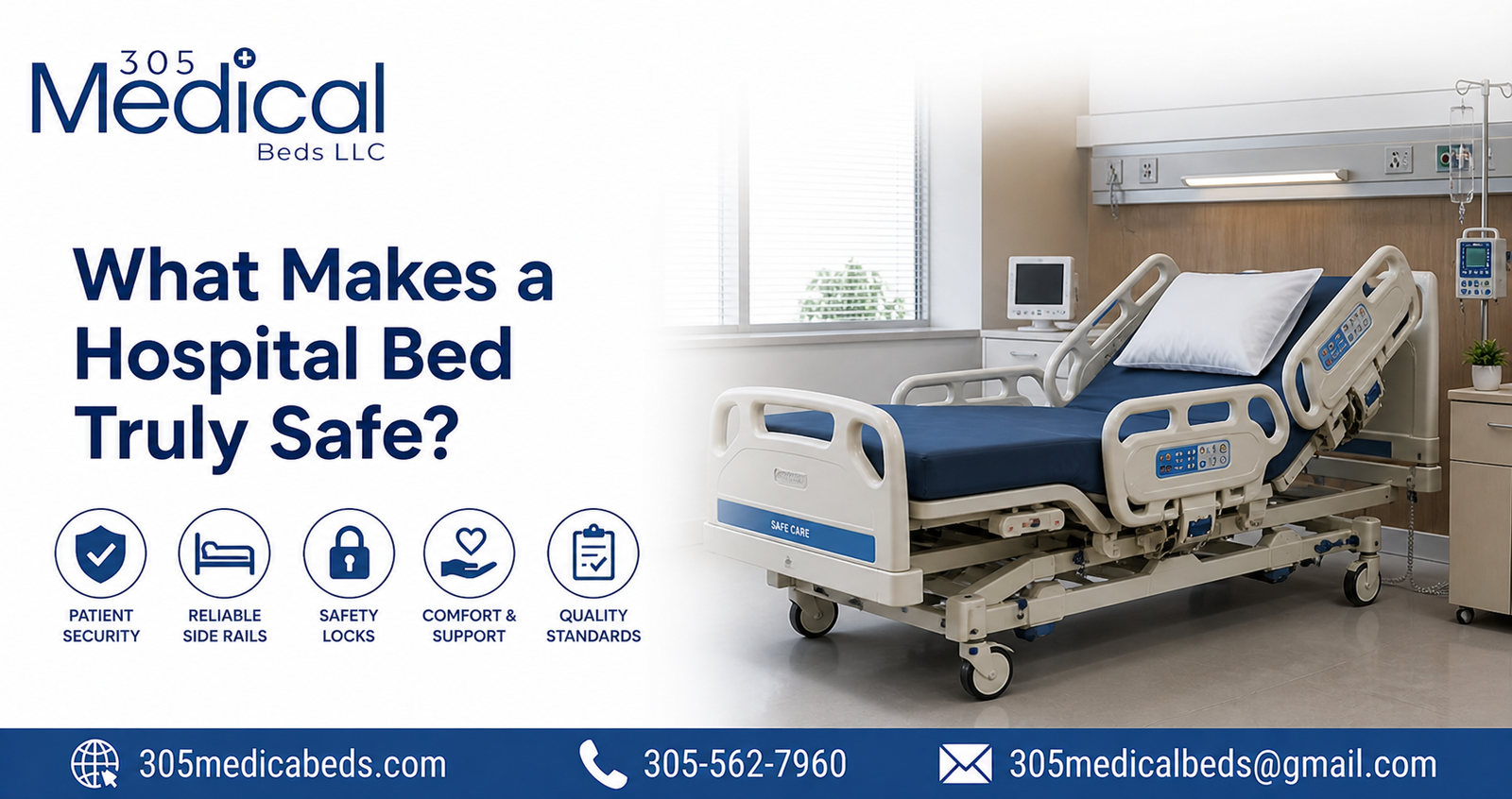
Quick Answer
A safe hospital bed includes side rail entrapment protection, low-height fall prevention, appropriate weight capacity, a pressure-relief mattress, lockable casters, and surfaces designed for infection control — all meeting FDA 510(k) clearance standards. The right combination depends on the individual patient’s needs.
Table of contents
- Quick Answer
- Key Takeaways
- The 8 Hospital Bed Safety Features That Matter Most
- 5. Brake and Caster Systems
- 6. Nurse Call and Monitoring Integration
- 7. Infection Control and Surface Materials
- 8. Positioning Controls and Backrest Articulation
- Home Hospital Bed vs. Clinical Hospital Bed — Key Safety Differences
- Hospital Bed Safety Self-Inspection Checklist
- How to Choose the right hospital bed for your situation
- Browse FDA-Cleared Hospital Beds
- Bottom Line
- Frequently Asked Questions
A hospital bed is not just a place to sleep. For patients recovering from surgery, managing chronic illness, or receiving long-term care, it is one of the most critical pieces of medical equipment in the room — and its hospital bed safety features can make a real difference in outcomes. At 305 Medical Beds, we believe every patient deserves a bed that is matched precisely to their safety needs.
Think about it: a patient may spend 90% of their day in that bed. Yet most people — caregivers, families, even some healthcare buyers — rarely stop to ask what actually makes a hospital bed safe. Is it the side rails? The mattress? The height adjustment? The answer is all of the above, and more.
In this guide, we break down every key hospital bed safety feature you need to understand — whether you are purchasing beds for a care facility, setting up a home care environment, or making a careful decision for a family member.
Key Takeaways
- Seamless, chemical-resistant bed surfaces reduce hospital-acquired infection (HAI) risk between patient admissions.
- Hospital beds with low-height configurations reaching 7–9 inches from the floor are clinically associated with reduced fall injury severity.
- The FDA identifies 9 specific entrapment zones that every cleared hospital bed must address in its design.
- Standard hospital beds are rated for 350–450 lbs; bariatric models handle 600–1,000 lbs or more.
- Alternating pressure mattresses cyclically shift pressure points and are recommended for immobile, high-risk patients.
- Central brake systems — locking all 4 casters with one pedal — are significantly safer than individual wheel brakes.
- Bed exit alarms reduce fall incidents by alerting staff when a high-risk patient attempts to rise unassisted.
The 8 Hospital Bed Safety Features That Matter Most
Before diving deep into each one, here is a structured overview of the key hospital bed safety features covered in this guide:
- 1Side rail design and entrapment preventionGap dimensions, locking integrity, and FDA zone compliance
- 2Height adjustment and fall preventionLow-height positioning, electric controls, Trendelenburg function
- 3Weight capacity and structural integrityStandard vs. bariatric ratings, frame stability
- 4Mattress system and pressure injury preventionFoam, alternating pressure, low air loss, lateral rotation
- 5Brake and caster systemsCentral vs. individual braking, color-coded indicators
- 6Nurse call and monitoring integrationBed exit alarms, CPR release, weight sensors
- 7Infection control and surface materialsSeamless design, disinfectant resistance, antimicrobial coatings
- 8Positioning controls and backrest articulationHead elevation, knee break, lockable positions
700K+
Patient falls in US hospitals each year (AHRQ)
09
FDA-defined entrapment zones on every hospital bed
2.5M
Pressure injuries treated annually in US care settings (NCBI)
30%
Falls that result in injury, many from beds (CDC)
1. Side Rail Design and Entrapment Prevention
Side rails are among the most visible and debated hospital bed safety features. A safe hospital bedside rail system prevents accidental falls while simultaneously protecting patients from entrapment — a documented and serious hazard recognized by the FDA.
The FDA identifies 9 entrapment zones on a hospital bed — areas between the mattress, side rails, bed frame, headboard, and footboard where a patient’s body, head, neck, or limbs can become dangerously trapped. Every FDA-cleared hospital bed must be designed to minimize risk across all 9 zones. Mattress-to-rail gaps exceeding approximately 1 inch are considered a significant entrapment hazard.
What to look for in safe side rails:
- Full-length vs. half-length rails: Half rails allow easier patient entry and exit, reducing the risk of climbing over and falling from a greater height — a common cause of serious injury.
- FDA entrapment zone compliance: Confirm that gaps between rails, mattress, and frame meet FDA Zone 1–9 specifications. Request documentation from the manufacturer.
- Solid locking mechanisms: Rails must lock firmly in both the raised and lowered positions. A partially engaged rail is more dangerous than no rail at all.
- Load-bearing capacity: Side rails must withstand a patient using them to pull upright, typically requiring a minimum lateral force tolerance of 250 lbs.
2. Height Adjustment and Fall Prevention
One of the most underappreciated hospital bed safety features is the bed’s ability to move vertically. A bed that lowers to within 7–9 inches of the floor dramatically reduces injury severity when a patient does fall — a configuration clinically referred to as a “low bed” or “ultra-low” position.
Falls from hospital beds remain one of the most common preventable incidents in both clinical and home care settings. According to the Agency for Healthcare Research and Quality (AHRQ), over 700,000 patient falls occur in US hospitals annually, and approximately 30% result in some form of injury. Bed height is one of the most modifiable contributing factors.
Key Height-Related Hospital Bed Safety Features:
- Low-height position: Beds that reach 7–9 inches from the floor minimize both fall frequency (patients feel the ground is accessible) and injury severity when falls occur.
- Trendelenburg and reverse Trendelenburg: A Trendelenburg position tilts the patient with the head lower than the feet — used to manage shock and circulatory issues. Reverse Trendelenburg tilts the opposite way, reducing aspiration risk. Both require precise electric control.
- Electric height adjustment: Manual height adjustment requires cranking or pumping, slowing emergency response. Full-electric controls allow instant repositioning at the touch of a button.
- Locking casters: Every safe hospital bed must have lockable casters that prevent the bed from rolling during patient transfers — one of the most common causes of both patient and caregiver injury.
3. Weight Capacity and Structural Integrity
A hospital bed’s weight capacity is a fundamental safety specification — not a secondary consideration. Standard hospital beds are rated for 350–450 lbs. Bariatric hospital bed models are engineered to support 600–1,000 lbs or more, with reinforced frames that meet ASTM F3186 standards for bariatric medical equipment.
Exceeding a bed’s rated weight capacity introduces three direct risks: frame failure or collapse, mattress compression that defeats pressure-relief design, and destabilized patient positioning that increases fall likelihood. As a general clinical guideline, the bed’s weight rating should exceed the patient’s actual body weight by at least 20%.
Clinical Guideline
Always select a hospital bed rated for at least 20% above the patient’s actual body weight. For a 350 lb patient, the minimum safe bed rating is 420 lbs. For bariatric care, choose beds certified to ASTM F3186 bariatric standards and confirm the entire support system — mattress, frame, and casters — is rated consistently.
4. Mattress Systems and Pressure Injury Prevention
The mattress is not a separate consideration from the bed frame — it is an integrated part of the hospital bed safety system. Pressure injuries (also known as pressure ulcers or bedsores) affect approximately 2.5 million patients annually in US care settings, according to the National Center for Biotechnology Information (NCBI). The right mattress is the primary preventive defense.
Foam Mattresses
Standard pressure distribution. Best for mobile or lower-risk patients. Short-term recovery use.
Alternating Pressure
Air cells inflate and deflate cyclically, constantly shifting pressure points. Ideal for immobile or high-risk patients.
Low Air Loss
Releases a gentle air stream to manage skin moisture and reduce maceration. Critical for wound care patients.
Lateral Rotation
Tilts the patient side-to-side automatically. Aids respiratory function and prevents secretion pooling.
Beyond type, the mattress must fit the bed frame precisely. Gaps exceeding approximately 1 inch between the mattress edge and the bed rails create entrapment hazards — a documented risk in the FDA’s Zone 6 and Zone 7 entrapment classifications. Always verify mattress-to-frame fit when combining components from different manufacturers.
5. Brake and Caster Systems
A hospital bed that moves unexpectedly during a patient transfer is one of the leading causes of both patient injury and caregiver musculoskeletal harm. The brake system is a critical and often overlooked hospital bed safety feature.
Central braking systems — where a single foot pedal locks all four casters simultaneously — are significantly safer than individual wheel brakes that require staff to crouch and engage each corner separately. In high-acuity or emergencies, the seconds saved by central braking are clinically meaningful.
- Color-coded brake indicators: Visual confirmation (typically red = locked, green = mobile) allows staff to verify bed status at a glance — reducing errors during fast-paced care moments.
- Swivel-lock dual function: Premium casters allow both full lock (no movement) and swivel lock (rolls straight only) — useful for controlled patient transport.
- Anti-tip design: Wide caster spacing and low center-of-gravity frame design prevent tipping during aggressive repositioning.
6. Nurse Call and Monitoring Integration
Modern hospital beds increasingly incorporate integrated technology designed to improve patient safety without creating additional burden for nursing staff. These medical bed safety technologies are especially important in facilities with high patient-to-nurse ratios.
- Bed exit alarms: Pressure-sensitive sensors detect when a fall-risk or cognitively impaired patient attempts to rise unassisted — triggering an alert to nursing staff before the patient reaches standing position.
- Continuous weight monitoring: Load sensors embedded in the bed frame provide real-time weight data, enabling passive monitoring for fluid retention changes or unplanned weight loss.
- Nurse call integration: The patient call button must connect directly to the facility’s nurse call system — not function as a standalone device that can go unnoticed during shift handoffs.
- CPR emergency release: A clearly labeled, color-coded CPR lever must instantly flatten the bed to allow unobstructed chest compressions — no delay, no searching for controls in an emergency.
7. Infection Control and Surface Materials
Hospital-acquired infections (HAIs) affect approximately 1 in 31 hospital patients on any given day, according to the CDC’s HAI prevalence data. The design and materials of a hospital bed’s surfaces play a direct role in how effectively the equipment can be cleaned and disinfected between patients — making this a non-negotiable hospital bed safety feature for any clinical setting.
- Seamless surfaces: Fewer joints, seams, and crevices provide fewer areas for bacteria and pathogens to accumulate between cleaning cycles.
- Chemical-resistant materials: Bed surfaces must withstand repeated exposure to medical-grade disinfectants — bleach solutions, quaternary ammonium compounds, and hydrogen peroxide variants — without cracking, discoloring, or degrading structurally.
- Fully removable, cleanable components: Rails, mattress platforms, call button housings, and control panels should all be accessible for thorough disinfection — not sealed units that trap contamination.
- Antimicrobial surface options: Some manufacturers offer beds with silver-ion or copper-infused surface coatings that provide passive antimicrobial activity between scheduled cleaning cycles.
8. Positioning Controls and Backrest Articulation
Correct patient positioning is both a comfort requirement and a clinical necessity. Incorrect positioning contributes to aspiration pneumonia, pressure injury development, respiratory decline, and post-surgical complications. Positioning controls are a foundational safe hospital bed feature for any patient with limited mobility.
- Head-of-bed elevation: Elevating the head of the bed to 30–45 degrees significantly reduces aspiration risk in ventilated patients and those with dysphagia or gastroesophageal reflux.
- Knee break function: Raising the knee section prevents the patient from sliding down when the head is elevated — reducing shear forces on skin and maintaining positioning without repeated manual repositioning by staff.
- Intuitive, labeled controls: Confusing or unlabeled controls lead to incorrect positioning and delayed responses. Controls should be clearly labeled, backlit if possible, and accessible to both patient and caregiver from multiple sides of the bed.
- Lockable position settings: Post-operative patients or those with specific clinical positioning requirements benefit from controls that can be locked by clinical staff to prevent accidental adjustment.
Home Hospital Bed vs. Clinical Hospital Bed — Key Safety Differences
Choosing between a home care model and a full clinical hospital bed depends on the patient’s specific needs. This comparison covers the most important hospital bed safety features across both categories:
| Safety feature | Home hospital bed | Clinical hospital bed |
|---|---|---|
| Low-height position (7–9 in.) | ✓ Available on most models | ✓ Standard on all models |
| Central brake system | Partial — varies by model | ✓ Standard |
| FDA 510(k) clearance | ✓ Required for all models | ✓ Required for all models |
| Integrated bed exit alarms | Partial — add-on accessory | ✓ Built-in on most models |
| Nurse call system integration | ✗ Not standard | ✓ Standard |
| Bariatric weight capacity | Partial — select models | ✓ Wide range available |
| Alternating pressure mattress | ✓ Compatible accessory | ✓ Compatible, often included |
| CPR quick-release | Partial — varies by model | ✓ Standard |
Hospital Bed Safety Self-Inspection Checklist
Whether you are setting up a safe hospital bed for home use or inspecting equipment in a care facility, use this checklist monthly to verify your bed’s safety status:
- Side rails lock firmly in both raised and lowered positions with no wobble.
- No visible gaps exceeding 1 inch between the mattress edge and the side rails
- The bed lowers to its minimum height setting without obstruction.
- All four casters lock completely when the brake is engaged — the bed does not move when pushed.
- All positioning controls (head, knee, height) respond correctly and smoothly.
- The CPR quick-release lever is accessible, labeled, and functioning
- Bed exit alarm (if equipped) triggers correctly when weight is removed from the mattress.
- All surface materials are intact — no cracks, tears, or seam separations.
- Nurse call button connects to the monitoring system and produces an audible alert.
- The bed weight rating is verified to exceed the patient’s body weight by at least 20%
How to Choose the right hospital bed for your situation
The safest hospital bed is the one that is correctly matched to the patient who will use it. A feature-rich bariatric bed is not necessarily safer for a lightweight, mobile patient than a basic semi-electric model — and vice versa. Answer these questions before purchasing a hospital bed for home use or for a clinical setting:
- What is the patient’s current weight and mobility level?
- Is the patient at elevated risk for falls, pressure injuries, or hospital-acquired infections?
- Will the bed be used in a clinical facility, a long-term care setting, or a home environment?
- Does the bed need to integrate with existing nurse call or patient monitoring systems?
- What is the expected duration of use — short-term post-surgical recovery or long-term care?
- Does the patient have specific positioning requirements (e.g., post-spinal surgery, respiratory condition)?
You can explore our full range of safety-certified hospital beds at 305 Medical Beds, including semi-electric, full-electric, bariatric, and home care models — each with documented hospital bed safety specifications to support your decision. For bariatric patients specifically, our bariatric hospital bed includes models rated from 600 to 1,000 lbs with ASTM F3186 certification.
Browse FDA-Cleared Hospital Beds
Find the right safety-certified bed for your patient, facility, or home care setup.
Bottom Line
A hospital bed is only as safe as its design, its maintenance, and how precisely it is matched to the patient’s needs. The hospital bed safety features covered in this guide — side rail entrapment protection, low-height fall prevention, weight-appropriate structural integrity, pressure-relief mattress systems, central braking, integrated monitoring, infection-resistant surfaces, and precise positioning controls — function as an interconnected safety system.
No single feature is sufficient on its own. Understanding each one, and how they work together, puts caregivers, families, and healthcare buyers in a position to make decisions that genuinely protect the people who depend on them. When in doubt, consult with a certified medical equipment specialist before purchasing.
Frequently Asked Questions
- What makes a hospital bed safe for patients at home?
For home use, a safe hospital bed combines a low-height position (reaching 7–9 inches from the floor), properly fitted half-length side rails, a pressure-relief mattress, and lockable casters. The bed must carry FDA 510(k) clearance and be rated for at least 20% above the patient’s actual body weight. - What is the safest hospital bed mattress for pressure injuries?
For patients at high risk of pressure injuries, an alternating pressure mattress — which cyclically inflates and deflates air cells to continuously shift pressure points — is the most widely recommended option. For patients with existing wounds or high moisture risk, a low air loss mattress system provides both pressure relief and skin moisture management. Always confirm the mattress fits the bed frame with gaps under 1 inch at all edges. - Are home hospital beds as safe as clinical models
Quality home hospital beds can meet the same core safety standards as clinical models — both must carry FDA 510(k) clearance. The main differences are in integrated monitoring (bed exit alarms, nurse call integration) and bariatric weight capacity. For home use, accessory bed exit alarm systems can compensate for built-in monitoring. Always verify that the bed’s specifications match the patient’s clinical needs. - How often should hospital beds be inspected for safety?
In clinical facilities, beds should be inspected at every patient admission and formally assessed on a scheduled maintenance cycle — typically every 6–12 months depending on usage intensity. In home settings, a visual inspection of rails, locks, casters, mattress fit, and controls should be performed monthly. Any sign of mechanical failure — a rail that doesn’t lock, a caster that doesn’t engage — warrants immediate service before continued use. - What are the FDA requirements for hospital bed safety?
The FDA classifies hospital beds as Class II medical devices regulated under 21 CFR Part 880. All hospital beds sold in the US must receive FDA 510(k) clearance, demonstrating substantial equivalence to an existing cleared device. The FDA’s guidance specifically requires manufacturers to address nine entrapment zones and provide documentation of entrapment testing results. - What is the safest hospital bed for elderly patients?
For elderly patients — particularly those with cognitive impairment, limited mobility, or fall history — the safest hospital bed configuration typically includes: ultra-low height positioning (7 inches from floor), half-length side rails to prevent climbing, a bed exit alarm, and a pressure-relief mattress. Full-electric controls allow safe repositioning without caregiver physical strain.