
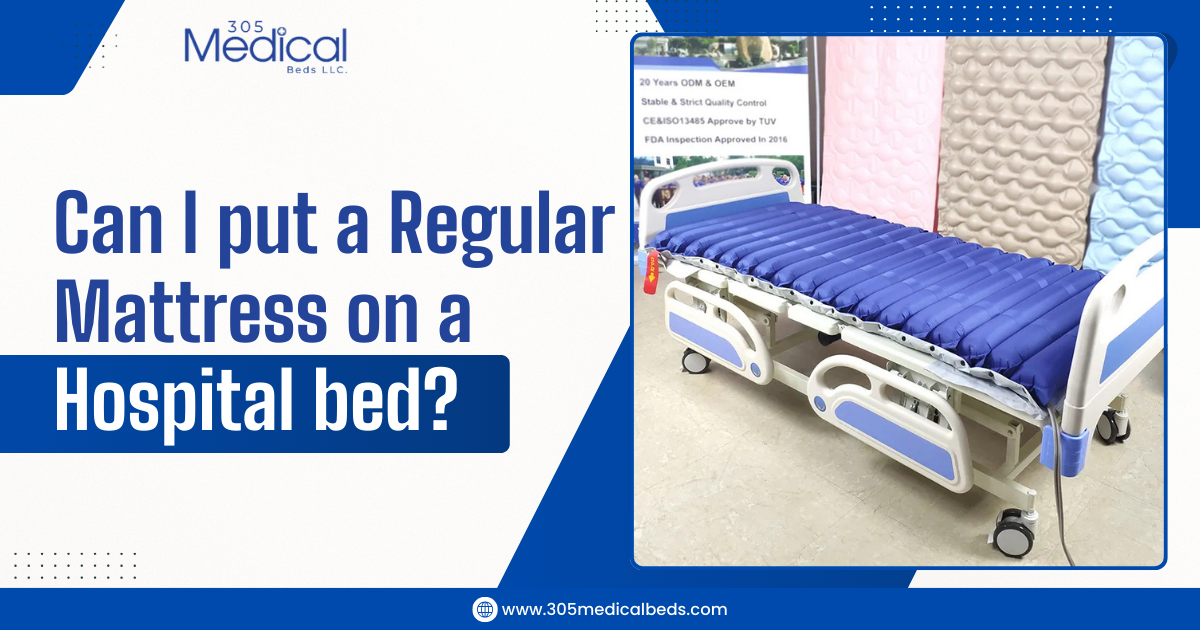
It’s one of those questions that seems simple at first — but the more you think about it, the more it matters. Maybe you’ve just rented or purchased a hospital bed for a family member at home. Maybe the mattress that came with it doesn’t feel comfortable enough. Or maybe you’re wondering if you can just swap in the memory foam mattress sitting in the spare room.
The short answer? It depends — and getting it wrong can affect both safety and recovery.
Let’s walk through everything you need to know about putting a regular mattress on a hospital bed, what actually works, and what your best options are.
What Makes a Hospital Bed Different From a Regular Bed?
Before answering whether a regular mattress works, it helps to understand why hospital beds are built differently in the first place.
A hospital bed is designed for medical functionality, not just sleep. Key features include:
- Adjustable head and foot sections that raise and lower electronically
- Height adjustment to assist caregivers with transfers and positioning
- Side rails for patient safety
- Built-in weight capacity for bariatric or high-dependency patients
- Compatibility with medical accessories like trapeze bars, IV poles, and pressure mattresses
These features mean the frame is not a flat, fixed surface like a standard bed frame. The mattress platform bends and flexes as the head and foot sections move. That single fact changes everything about what type of mattress can safely go on it.
So Can You Put a Regular Mattress on a Hospital Bed?
Technically, you can place a regular mattress on a hospital bed in some situations — but in most cases, it’s not recommended. Here’s why.
The Size Problem
Standard hospital bed mattresses are typically 36 inches wide x 80 inches long — narrower than a standard twin mattress (38″ x 75″) and longer. A regular twin or full mattress will almost never be a clean fit. It may overhang the sides, leave gaps near the rails, or bunch up when the bed adjusts.
The Flexibility Problem
This is the bigger issue. Regular mattresses — especially memory foam, innerspring, or thick hybrid mattresses — are not designed to bend. When the head or foot section of a hospital bed raises, a rigid mattress will either:
- Resist the movement and strain the bed’s motor
- Buckle and fold awkwardly, creating uncomfortable pressure points
- Slide out of position, creating a safety hazard
The Thickness Problem
Most hospital bed frames are designed for mattresses 5 to 7 inches thick. A standard home mattress is often 10 to 14 inches thick. A thick mattress raises the patient’s sleeping surface too high relative to the side rails — which are there to prevent falls. If the patient’s body is at or above rail height, those rails offer no protection.
What Happens If You Use the Wrong Mattress?
Using an incompatible mattress on a hospital bed isn’t just uncomfortable — it can be genuinely dangerous:
- Fall risk increases when the mattress sits too high relative to the side rails
- Pressure ulcers can develop faster if the mattress doesn’t flex with the bed, creating uneven weight distribution
- Bed motor damage can occur if a rigid mattress resists the frame’s movement
- Caregiver strain increases when positioning and transfers become harder due to improper mattress height
- Patient discomfort worsens when the mattress folds or shifts during position changes
For patients who are already vulnerable — elderly, post-surgical, or with limited mobility — these risks are not trivial.
When Can a Regular Mattress Work on a Hospital Bed?
There are limited scenarios where a regular mattress might be acceptable:
- If the hospital bed is used in a fixed, flat position and the adjustable functions are not being used — for example, a fixed-height bed used purely for caregiver access convenience
- If the mattress is a thin, flexible foam type (like a simple 4-inch foam topper) that can bend without resistance
- If the dimensions match closely enough that there are no significant overhangs or gaps near the side rails
Even in these cases, it’s worth consulting the bed manufacturer’s guidelines or a medical equipment supplier before proceeding. What works in theory doesn’t always work safely in practice.
Final Thoughts
Putting a regular mattress on a hospital bed might seem like an easy solution, but the risks — from fall hazards to pressure injuries to motor damage — make it a decision worth thinking through carefully. Hospital beds are precision equipment, and the mattresses designed for them are built to match that precision.
The good news is that purpose-built hospital bed mattresses have come a long way. From comfortable gel foam to advanced alternating pressure systems, there are options that provide genuine comfort and meet the clinical demands of home care.
At 305 Medical Beds, we carry a full range of hospital beds and compatible mattresses for every care need and budget. Whether you’re setting up a home care room for the first time or upgrading an existing setup, we’re here to help you make the right call.
Frequently Asked Questions
Can I use a memory foam mattress on a hospital bed? Standard memory foam mattresses are generally too thick and too rigid to work safely with an adjustable hospital bed frame. If you prefer the feel of memory foam, look for a thin (4–5 inch) memory foam mattress specifically sized for hospital beds.
What size mattress fits a hospital bed? Most standard hospital beds take a 36″ x 80″ mattress. Always measure your specific frame and check the manufacturer’s specifications before purchasing.
Can I add a mattress topper to a hospital bed mattress? Yes — a thin foam or gel topper (1–2 inches) can add comfort without significantly affecting the bed’s function. Avoid thick or rigid toppers that may interfere with the adjustable sections.
Are hospital bed mattresses covered by insurance? In some cases, yes. Pressure-relief mattresses prescribed by a physician may be covered under Medicare or private insurance for qualifying patients. Check with your provider or ask us for guidance.